Fournir la meilleure expérience utilisateur possible est aujourd’hui un enjeu pour les entreprises. Cela permet de gagner et fidéliser des clients, et d’accroître le chiffre d’affaires. Il est donc essentiel de fluidifier au maximum le parcours utilisateur et d’éliminer tous les obstacles, tout en améliorant les performances d’un site.
Parmi les solutions disponibles, se trouve la digital experience monitoring (DEM), que l’on peut traduire en français par la surveillance de l’expérience digitale.
Offrant des informations en temps réel, la DEM aide à comprendre le comportement des utilisateurs d’un site. Dans cet article, nous vous expliquons ses objectifs, son fonctionnement et ses avantages.
DEM, APM, RUM : quelles différences ?
Le Digital Experience Monitoring est souvent confondu avec d’autres approches de surveillance. Voici les différences essentielles à connaître pour choisir la bonne solution :
| Critère |
☁️
DEM
|
⚙️
APM
|
👥
RUM
|
|---|---|---|---|
| Signification | Digital Experience Monitoring |
Application Performance Monitoring |
Real User Monitoring |
| Point de vue | 👤 Utilisateur final | ⚙️ Infrastructure & code | 👥 Vrais utilisateurs |
| Type de surveillance | ✦ Proactive & synthétique | Réactive (alertes techniques) | Passive (analyse du trafic) |
| Détecte avant incident ? | ✅ Oui — 24h/24 | ❌ Non — réactif | ❌ Non — a posteriori |
| Parcours complet ? | ✅ De bout en bout | ❌ Couche technique | ⚠️ Partiel |
| Impact business visible ? | ✅ Conversion, MTTR, NPS | ❌ Métriques IT seules | ⚠️ Partiel |
| Idéal pour | Grands comptes, e-commerce, banque, assurance |
Équipes dev / DevOps | Analyse UX & comportement |
| Exemples d’outils | 2Be-FFICIENT | Datadog Dynatrace New Relic | Contentsquare Hotjar |
Le DEM complète les outils APM : là où Datadog ou Dynatrace surveillent l’infrastructure, le DEM surveille ce que vos utilisateurs vivent réellement. Ce sont deux approches complémentaires, pas concurrentes.
Qu’est-ce que la DEM (Digital Experience Monitoring) ?
Le digital experience monitoring est une approche globale de la supervision de site ou d’application qui analyse le comportement des utilisateurs et mesure les performances du site. Grâce aux données collectées, la DEM permet :
- d’obtenir des informations précises sur l’expérience de visite d’un site et ainsi, de comprendre le parcours des utilisateurs ;
- d’identifier et de corriger des erreurs, des anomalies qui nuisent à la bonne expérience utilisateur (UX).
En d’autres termes, il offre une vue détaillée et uniforme du parcours utilisateur en associant des données techniques et comportementales. Il s’agit d’une surveillance proactive, qui fonctionne en temps réel et analyse les causes profondes d’un problème, d’un manque de performance ou encore, d’un dysfonctionnement.
Le digital experience monitoring s’avère donc indispensable dans les environnements complexes, pour les sites e-commerce et services basés sur le cloud notamment.
Le Digital Experience Monitoring combine généralement plusieurs techniques : le monitoring synthétique, le Real User Monitoring (RUM) et parfois l’Application Performance Monitoring (APM).Quels sont les objectifs du digital experience monitoring ?
La surveillance de l’expérience digitale remplit plusieurs objectifs. Elle fournit
des informations exploitables sur :
- les performances des applications SaaS, privées ou cloud qui utilisent des protocoles HTTP par exemple et s’exécutent sur les appareils des utilisateurs et peuvent nuire à leur expérience en cas de problème, de lenteur ;
- la latence du réseau ;
- le comportement des utilisateurs.
La DEM permet aussi de surveiller, analyser et mesurer les expériences digitales des utilisateurs. Le but final est d’améliorer :
- les performances d’un site ;
- l’expérience utilisateur ;
- l’engagement et la satisfaction client ;
- la productivité.
Comment fonctionne la surveillance de l’expérience digitale (DEM) ?
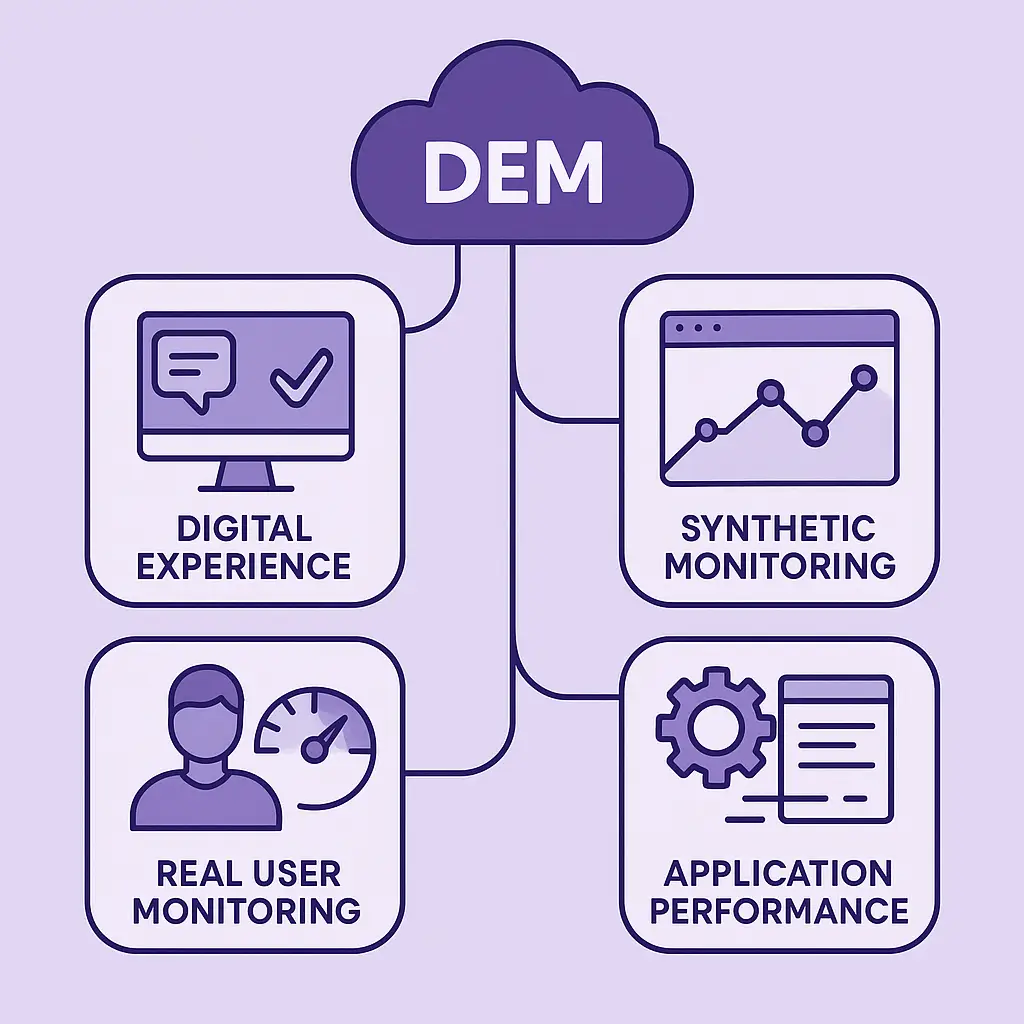
Le digital experience monitoring repose sur des techniques avancées pour analyser et optimiser les interactions des utilisateurs avec les services numériques. Pour collecter ces données, plusieurs outils sont utilisés :
- La surveillance des utilisateurs réels (RUM) qui suit les données des visiteurs réels d’un site et permet d’analyser différentes métriques (réactivité des pages, temps de chargement moyen par exemple). Grâce à ces données, il est ainsi possible de repérer les opportunités d’optimisation d’un site.
- La surveillance synthétique (STM) qui simule les interactions d’utilisateurs à l’aide d’automates (des bots) afin de tester les performances de pages spécifiques. Cet outil est très utile pour tester de nouvelles fonctionnalités avant leur lancement.
- La surveillance des applications (APM) qui identifie et analyse les paramètres clés des applications logicielles. Elle permet de détecter les problèmes de performances techniques de ces applications, qui nuisent à une bonne expérience utilisateur. C’est le cas par exemple des goulets d’étranglement. Pour aller plus loin, découvrez comment notre solution de monitoring API permet de mesurer la fiabilité des échanges entre les systèmes.
- La surveillance des points finaux (ou points de terminaison) qui veille aux performances optimales des ordinateurs et des téléphones mobiles en surveillant différents paramètres, dont leurs performances et la qualité de la connexion. Cela permet de garantir la productivité, d’identifier puis de résoudre de manière proactive les anomalies pouvant perturber le parcours et l’expérience de l’utilisateur final. Cette approche est complémentaire de notre solution de monitoring des applications mobiles.
- La surveillance DevOps qui se concentre sur les performances des flux de travail de développement afin de repérer et résoudre des problèmes de performance.
- La supervision des performances réseaux (NPM) qui évalue la fiabilité et les performances de l’infrastructure réseau sous-jacente (la vitesse, la latence par exemple) afin de garantir une connectivité transparente dans les environnements.
Interagissant en temps réel, ces outils permettent :
- d’établir des liens entre les différentes données obtenues, qui sont rassemblées dans un tableau de bord
- de repérer les erreurs ou problèmes pouvant impacter négativement l’expérience utilisateur
- de détecter une baisse de performances des applications et sa cause (hausse de trafic ralentissant le chargement des pages d’un site par exemple)
- de résoudre les problèmes identifiés.
Le monitoring de l’expérience digitale surveille et analyse les performances et le bon fonctionnement d’un site de deux points de vue : technique et celui de l’utilisateur. Il s’agit donc d’une solution très complète.
Pourquoi ce type de surveillance est stratégique pour les entreprises ?
La DEM permet un gain de temps et une réduction des coûts et ainsi, d’améliorer la satisfaction des utilisateurs et la productivité de l’organisation utilisant cette surveillance. Des avantages indéniables pour une entreprise, car ils contribuent à augmenter son chiffre d’affaires.
Offrir une meilleure expérience utilisateur
Le digital experience monitoring est un bon outil pour garantir la qualité de l’expérience utilisateur en comprenant mieux le comportement, les attentes d’un utilisateur. Il peut ainsi aider une entreprise à se démarquer de ses concurrents et à identifier les problèmes, les erreurs ayant des conséquences sur l’UX et pouvant impacter le taux de conversion d’un site.
Détecter des erreurs de manière proactive
Avec un suivi de l’expérience numérique, des alertes sont envoyées en temps réel lorsque des problèmes sont détectés. Il est ainsi possible de les résoudre rapidement avant qu’ils ne nuisent à l’UX, à l’activité de l’entreprise et affectent les clients, en les empêchant par exemple de finaliser leurs achats en ligne.
Identifier les causes des anomalies ou problèmes
Cette surveillance de l’expérience digitale ne permet pas seulement de repérer des problèmes. Elle va plus loin en identifiant leurs causes grâce aux différentes données qu’elle collecte, ce qui est indispensable afin d’éviter qu’ils se reproduisent. Par exemple, avec le digital experience monitoring, il est possible de comprendre pourquoi le taux de rebond d’un site augmente. Elle offre une vision globale du comportement des internautes.
Faciliter la collaboration entre les équipes
Comme nous l’avons précédemment indiqué, la DEM profite aussi aux équipes de l’entreprise utilisatrice en facilitant les flux de travail internes. Elle apporte en effet une plus grande visibilité sur l’ensemble de l’infrastructure aux équipes, qui peuvent ensuite travailler à l’amélioration de l’UX et régler plus rapidement les problèmes.
Orienter les décisions stratégiques
A partir des données exploitables issues des comportements des utilisateurs et des mesures de performance du site, une entreprise peut définir les axes d’amélioration prioritaires et les correctifs à apporter sur le site. L’objectif étant, une fois encore, d’optimiser l’expérience utilisateur afin de fidéliser les clients et augmenter le taux de conversion du site.
La DEM permet aussi à une entreprise de se distinguer de la concurrence en plaçant l’UX au cœur de ses priorités et en fournissant aux internautes une expérience fiable et de qualité. Dans un secteur concurrentiel, cela s’avère un réel atout.
Enfin, une solution de monitoring de l’expérience digitale étant évolutive, elle s’adapte vraiment aux besoins de l’entreprise et de son activité.
Quels sont les avantages de la Digital Experience Monitoring (DEM) ?
Ces deux solutions peuvent sembler similaires. Il est vrai qu’elles sont liées et complémentaires, mais leurs objectifs ne sont pas identiques.
En effet, le monitoring surveille principalement le parcours des utilisateurs et identifie les anomalies techniques d’un serveur, d’un réseau.
La DEM, quant à lui, va au-delà en veillant à la disponibilité et aux performances d’un site tout en se concentrant sur l’expérience réelle de l’utilisateur final :
- il fournit des informations précises sur la manière dont les utilisateurs interagissent avec les services d’un site et se base sur les indicateurs clés de la performance d’un site (temps de chargement, latence par exemple)
- il favorise la détection des problèmes avant que les utilisateurs les repèrent et se plaignent alors que le monitoring classique est une méthode de surveillance passive
- il prend en compte un contexte global et analyse les performances quel que soit l’environnement de l’utilisateur (son emplacement géographique, son appareil, son navigateur par exemple)
- il aide à quantifier l’impact d’un problème de performance sur les ventes, la productivité d’une entreprise, ce qui n’est pas le cas du monitoring classique qui ne relie pas ces données
- il est adapté aux architectures modernes (cloud, SaaS, hybrides) alors que le monitoring classique suit difficilement ce qui sort du périmètre IT
L’impact réel des défaillances digitales
Les incidents ne sont pas que des problèmes techniques — ils ont un impact direct et mesurable sur les revenus et la fidélisation des clients.
| Secteur | Chiffre clé | Impact sur votre activité |
|---|---|---|
|
Mobile
|
38 % des utilisateurs ont désinstallé une application en raison de performances médiocres Statista, 2023 |
Perte directe de clients fidèles après un seul incident non résolu
|
|
Web global
|
39,6 % des sessions en ligne impactées par des frustrations (erreurs JavaScript, temps de chargement) Contentsquare, 2023 |
Baisse directe du taux de conversion sur chaque page affectée
|
|
Banque
|
7 % de perte de conversions par seconde de délai supplémentaire sur un parcours transactionnel Akamai |
Abandon de souscription, virement ou connexion — avant toute alerte IT
|
|
E-commerce
|
70 % de taux d’abandon de panier en moyenne — la lenteur et les erreurs en sont une cause principale Baymard Institute |
Perte de revenus directs à chaque transaction non finalisée
|
|
SVI / Vocal
|
Quelques min. suffisent pour qu’un SVI défaillant non détecté génère des centaines d’appels en débordement Observations terrain |
Surcharge immédiate des centres d’appels et insatisfaction client visible
|
A qui s’adresse la surveillance de l’expérience digitale ?
En collectant et analysant des données techniques et comportementales, la digital experience monitoring (DEM) permet de détecter des anomalies, des erreurs, puis de les corriger. Cette surveillance proactive répond donc aux besoins des entreprises de différents secteurs, quelle que soit leur taille, dont :
- le commerce en ligne
- les télécommunications
- l’éducation
- la santé.
De même, les données récoltées ne sont pas uniquement intéressantes pour les équipes informatiques et techniques. Elles le sont aussi pour les équipes commerciales et créatives, car ces données les aident à définir les axes d’amélioration d’un site et à mieux collaborer entre elles.
En fait, toute entreprise ayant un site internet ou une application, peut opter pour le digital experience monitoring dans le but de :
- augmenter son taux de conversion ;
- proposer une meilleure expérience utilisateur ;
- améliorer les performances de son site ;
- obtenir des informations sur le comportement des utilisateurs afin de mieux les comprendre et répondre à leurs attentes.
Cela concerne donc aujourd’hui de nombreuses structures, d’autant que la plupart des solutions de DEM s’intègrent aux systèmes existants. Cela évite de devoir apporter d’importants changements à une infrastructure et d’avoir des coûts supplémentaires.
Le DEM en pratique : cas d’usage par secteur
Le monitoring de l’expérience digitale répond à des enjeux très concrets selon votre secteur d’activité. Voici les cas d’usage les plus critiques :
Banque & Assurance
Les parcours bancaires sont parmi les plus critiques : une anomalie sur un virement, une souscription ou une connexion sécurisée peut avoir des conséquences réglementaires et financières immédiates.
• Surveillance continue des parcours de connexion (authentification forte, MFA)
• Monitoring des virements et paiements en temps réel
• Détection des anomalies sur les espaces clients avant signalement utilisateur
• Vérification des déclarations de sinistres et souscriptions en ligne
• Exemple : une banque détecte en moins de 2 minutes qu’un parcours de virement est bloqué à l’étape de validation — avant qu’un seul client ne soit impacté.
Exemple concret : découvrez comment LCL a mis en place le monitoring de ses parcours digitaux bancaires avec 2Be-FFICIENT →
E-commerce & Retail
Chaque seconde de friction sur un tunnel d’achat se traduit directement en abandons de panier et perte de revenus.
• Surveillance du tunnel d’achat complet : ajout au panier → paiement → confirmation
• Monitoring des promotions et pages flash (Black Friday, soldes)
• Vérification des intégrations de paiement (CB, PayPal, Apple Pay)
• Surveillance du click & collect et des applications mobiles
• Exemple : un retailer détecte automatiquement qu’une page de paiement renvoie une erreur uniquement sur mobile iOS — invisible sur desktop et sur les outils APM classiques.
Énergie & Utilities
Les portails clients et applications de gestion de contrat sont des points de contact essentiels pour la satisfaction client.
• Monitoring des espaces clients (consultation de factures, contrats, consommation)
• Surveillance des portails de déclaration d’incidents et pannes
• Vérification des applications de suivi de consommation en temps réel
• Exemple : un fournisseur d’énergie est alerté immédiatement qu’une mise à jour a cassé le formulaire de changement de coordonnées bancaires — avant toute remontée client.
Distribution & Logistique
La digitalisation des parcours logistiques crée de nouveaux points de défaillance invisibles aux outils techniques classiques.
• Surveillance des applis mobiles de livraison et suivi de colis
• Monitoring des interfaces B2B (commandes, EDI, API partenaires)
• Vérification des parcours de retour et remboursement
• Exemple : une enseigne de distribution détecte qu’une API de suivi de commande répond avec 8 secondes de latence uniquement le week-end — corrélé à une augmentation des contacts SAV.
Pourquoi choisir la solution 2Be-FFICIENT pour votre monitoring ?
2Be-FFICIENT, spécialiste de la surveillance de l’expérience utilisateur, vous propose une solution innovante de monitoring de l’expérience digitale qui vous :
- permet d’analyser et mesurer l’expérience de chaque utilisateur, quel que soit l’appareil utilisé (ordinateur fixe, portable, mobile ou tablette) ;
- alerte en temps réel lorsque des anomalies, des erreurs sont détectées pour que vous puissiez agir immédiatement et les résoudre, les corriger ;
- fournit des diagnostics préalables afin d’identifier au plus vite l’origine d’un problème et intervenir rapidement et efficacement.
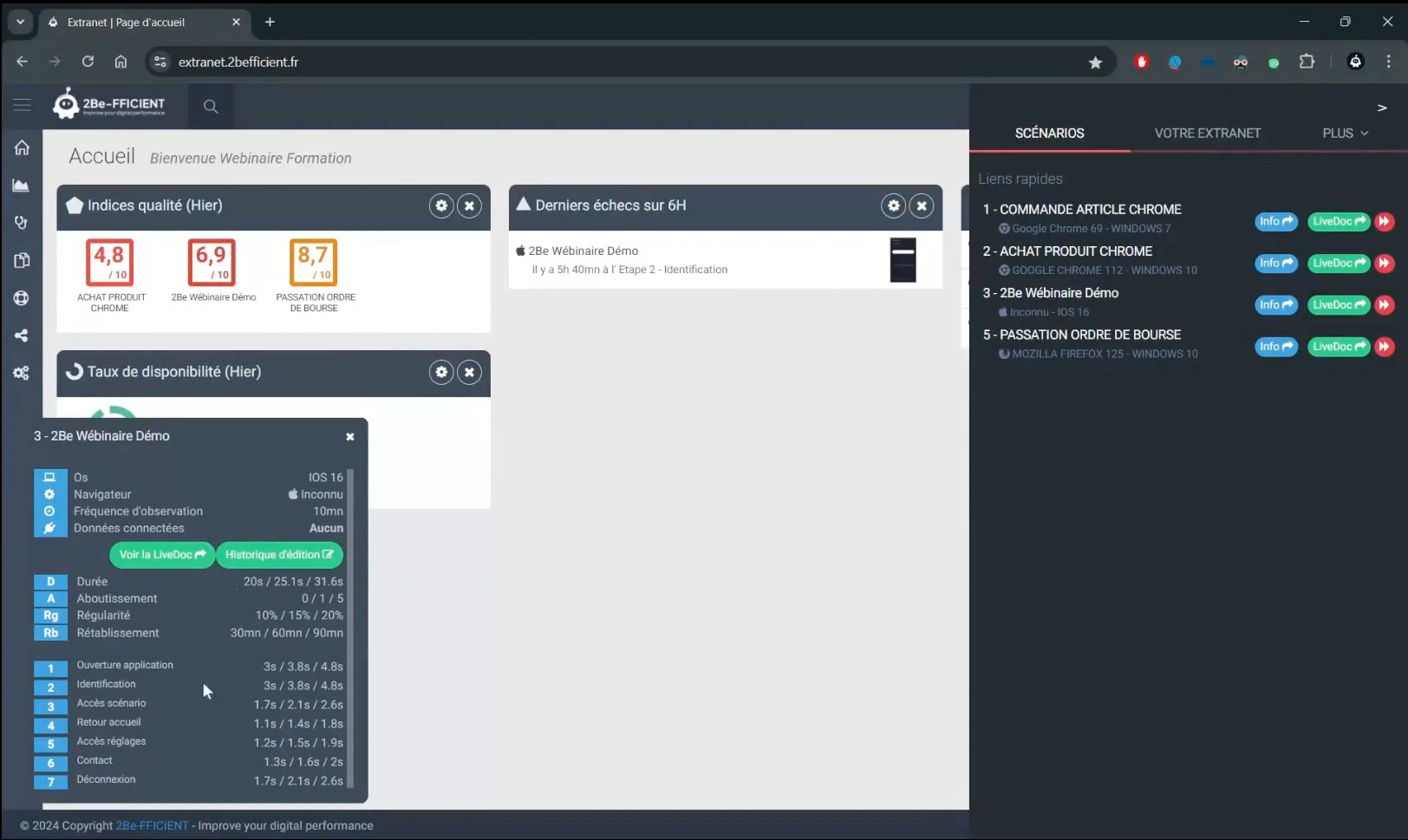
Cette surveillance se fait via des automates, qui sont indépendants de votre structure informatique. De même, lorsque des incidents sont repérés, ils sont enregistrés (vidéo et captures d’écran) pour mieux les identifier.
Notre solution intègre aussi une IA pour simplifier l’analyse des erreurs, des problèmes. Conçue pour s’adapter à des infrastructures complexes, elle est déployée rapidement par nos équipes. Quant aux alertes, vous pouvez les personnaliser, comme les statistiques intégrées à votre tableau de bord.
Pour en savoir plus et découvrir les avantages du digital experience monitoring par 2Be-FFICIENT, n’hésitez pas à demander votre démo en ligne !
FAQ — Questions fréquentes sur le Digital Experience Monitoring
Quelle est la différence entre le DEM et le monitoring classique ?
Le monitoring classique surveille la disponibilité des serveurs et des infrastructures IT.
Le DEM (Digital Experience Monitoring) va plus loin : il reproduit les parcours des utilisateurs réels pour détecter les anomalies qui impactent l’expérience client mais qui n’apparaissent pas sur les tableaux de bord techniques.
Un serveur peut être « vert » sur votre dashboard IT pendant qu’un parcours de paiement est bloqué pour vos clients.
Le DEM remplace-t-il les outils APM comme Datadog ou Dynatrace ?
Non, le DEM et les APM sont complémentaires. Les APM (Datadog, Dynatrace, New Relic) surveillent l’infrastructure et le code.
Le DEM surveille l’expérience réelle des utilisateurs finaux. Les deux approches fonctionnent ensemble : l’APM pour détecter les causes techniques, le DEM pour mesurer l’impact utilisateur réel.
De nombreuses entreprises utilisent les deux en parallèle.
Qu'est-ce que le monitoring synthétique ?
Le monitoring synthétique est une technique qui consiste à simuler automatiquement des parcours utilisateurs à intervalles réguliers, depuis l’extérieur de votre infrastructure, 24h/24 et 7j/7.
Des robots reproduisent les actions d’un vrai utilisateur (connexion, ajout au panier, paiement, souscription…) et détectent les anomalies avant que vos vrais clients ne les rencontrent.
C’est la technique principale utilisée dans le Digital Experience Monitoring.
Quelle différence entre le monitoring synthétique et le RUM ?
Le monitoring synthétique simule des parcours en permanence depuis l’extérieur, même sans trafic réel, idéal pour la détection proactive.
Le RUM (Real User Monitoring) analyse le comportement de vrais utilisateurs en temps réel, mais ne fonctionne que quand il y a du trafic et de manière réactive.
Le DEM combine idéalement les deux approches pour une couverture complète.
Le DEM est-il utile pour les applications mobiles ?
Oui, c’est même l’un de ses points forts. Le DEM peut surveiller les parcours sur de vrais appareils mobiles (smartphones Android et iOS réels, pas des émulateurs), sur tous les navigateurs et systèmes d’exploitation. Il détecte les anomalies spécifiques au mobile qui passent inaperçues sur les tests desktop : authentification par SMS, notifications push, performance sur réseau 4G/5G, etc.
Faut-il installer quelque chose sur son infrastructure pour le DEM ?
Non. C’est l’un des avantages clés du monitoring synthétique : les automates sont situés à l’extérieur de votre infrastructure. Aucune modification de vos systèmes d’information n’est nécessaire, aucun agent à installer, aucun impact sur la production. Le déploiement est rapide et non intrusif.
Quels secteurs ont le plus besoin du Digital Experience Monitoring ?
Les secteurs les plus critiques sont la banque et l’assurance (parcours réglementés, transactions financières), le e-commerce (tunnel d’achat et taux de conversion directement impactés), l’énergie et les utilities (portails clients et déclarations en ligne), et la distribution (applications mobiles et click & collect). En pratique, toute entreprise dont le chiffre d’affaires dépend de parcours digitaux critiques peut bénéficier du DEM.
Comment mesure-t-on le ROI du Digital Experience Monitoring ?
Le ROI se calcule sur plusieurs axes : réduction du MTTR (temps moyen de résolution des incidents), diminution des contacts SAV liés aux dysfonctionnements digitaux, augmentation du taux de conversion sur les parcours surveillés, et réduction des pertes de revenus liées aux incidents non détectés. Les équipes utilisant le DEM passent généralement d’une gestion réactive des incidents (remontés par les clients) à une gestion proactive (détectés avant impact client).