API monitoring: a trusted third party to see
beyond the 200 code
Monitor your critical interfaces, ensure service continuity, and optimize the performance of your interconnected systems with our API monitoring solution!
Limits of conventional PLC monitoring
Validating that an API responds with an HTTP 200 code is no longer sufficient today. Indeed, in modern information systems, API flows are at the heart of the user experience and business processes.
- Critical malfunctions masked by simple API calls
- APIs with strong authentication (e.g. DSP2) not tested under real-life conditions.
- Intermittent errors, drops in performance or service degradations often invisible to detection.
Reliable, real-time automated API monitoring that complies with your security requirements
Proactively monitor the health, availability, and response times of your APIs—whether they are public, private, or highly secure. Our solution automated API interface testing solution integrates seamlessly with your monitoring, security, and service quality requirements.
Automated tests suitable for all types of APIs
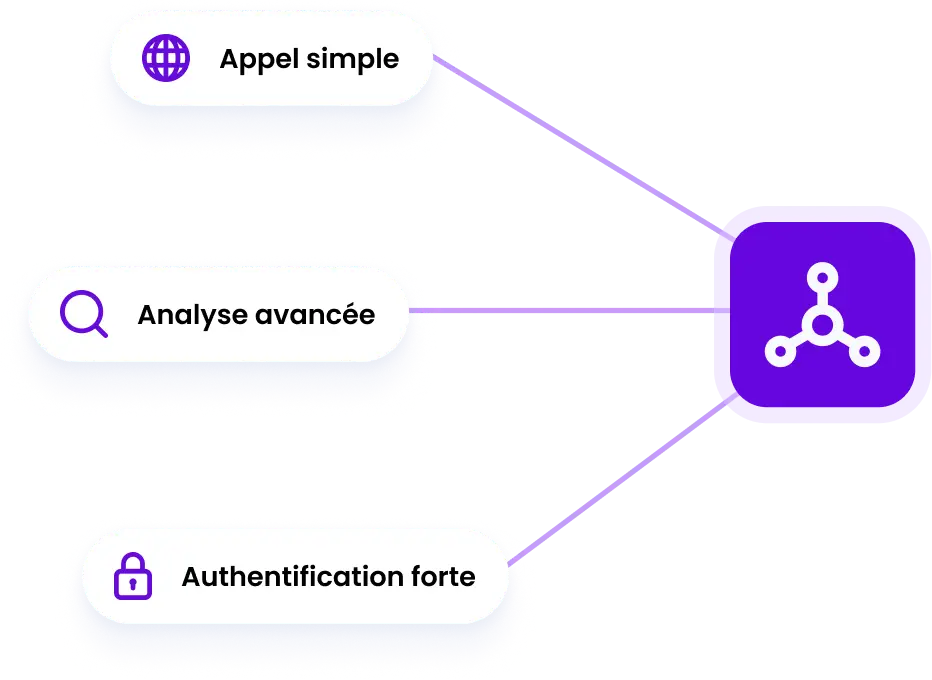
- Monitoring of single calls on public or internal endpoints.
- Management of strong authentication mechanisms: mTLS, OAuth2 flows with validation performed on a mobile application or website.
- Comprehensive analysis of behavior during automated API testing: return codes, response content, latency, logical or business errors.
Advanced safety adapted to the most stringent standards:

- Integration via signed customer certificates (CSR), supplied or validated by your internal authorities.
- Secure connection when running automated API tests via dynamic certificate retrieval from external HSMs (e.g., Azure Key Vault).
Monitoring API with Opale, our embedded AI
Thanks to our Opale AI, our solution goes beyond traditional API monitoring. Opale analyzes each automated API test. It enriches alerts with useful and actionable data, facilitating diagnosis and remediation.
- Clear summary of each error detected, usable even without technical expertise.
- Automatic incident classification (technical, functional, network, security, etc.).
- Reliability index from 0 to 5 to distinguish critical errors from false positives.
- Restitution of data from test automation in our monitoring console or via your tools: email, Slack, Teams, webhook, etc.
Expert customer support and customized assistance
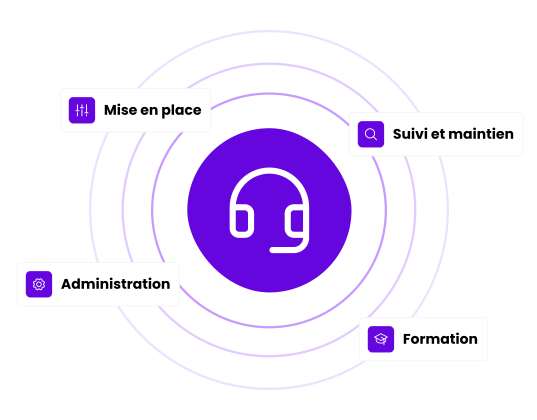
Our team supports you every step of the way of API monitoring, with a turnkey approach or a gradual increase in autonomy depending on your needs.
- Automated scenarios configured based on your technical documentation (Swagger, Postman, OpenAPI, curl, etc.)
- Can be linked to your desktop, mobile or hybrid journeys
- Continuous adaptation of test automation to changes in your APIs, versions, headers, tokens, response formats, etc.
- Coming soon: a self-service editor to create your own scenarios independently.
- Specific support for sensitive APIs (banking, healthcare, energy, etc.).
Key features of our API monitoring
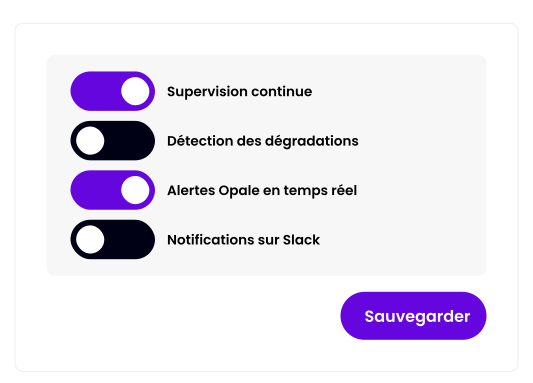
- Continuous supervision 24/7, without interruption.
- Call frequency configurable from 1 min.
- Immediate detection of performance degradations or downtime.
- Real-time alerts enhanced by Opale.
- API test automation
- Query analysis: allows you to view directly from the Extranet the sequences of interactions between the client and your servers.
- Customizable dashboards that can be shared with business and IT teams.
- Complete history retained for 13 months for analysis, reporting, and compliance. The exhaustive content of network exchanges is retained in its entirety, including network captures from the transport layer.
What our clients say
Whether you are monitoring multiple platforms or anticipating incidents, our API monitoring offers you optimal responsiveness.
Designed for an exceptional experience
Discover the key benefits of your future monitoring solution API with automated testing!
Continuous monitoring 24/7
Ensure a continuously optimal user experience with automated and proactive monitoring, replicating your users' actions at all times.
Define your key path
Select the critical steps of the user journey that you want to monitor continuously.
Automated scenario execution
Our robots exactly reproduce your users' journeys, simulating each interaction to detect invisible errors.
Immediate detection of friction
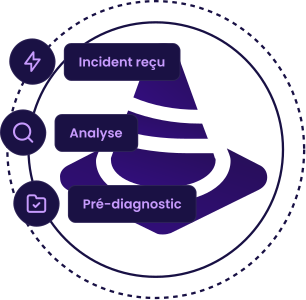
In the event of a problem (blocked form, excessive loading time, etc.), an alert is triggered with a precise pre-diagnosis.
Access to detailed and shareable data
Consult statistics and diagnostics directly from your dashboards, and easily share them with the teams concerned.
Analysis and rapid resolution
Use 2Be-FFICIENT's observations to correct points of friction and provide a smooth, frustration-free experience for your users.
Real-time alerts and preliminary diagnostics
Receive an immediate alert as soon as a problem occurs, accompanied by a diagnosis that helps you react quickly.
SMS
Push notifications
Voice alerts
SMS
Slack
Signal
Discord
Microsoft Teams
Slack
Signal
Discord
Proactive resolution of user friction
By identifying points of friction, 2Be-FFICIENT optimizes each path for a seamless experience.
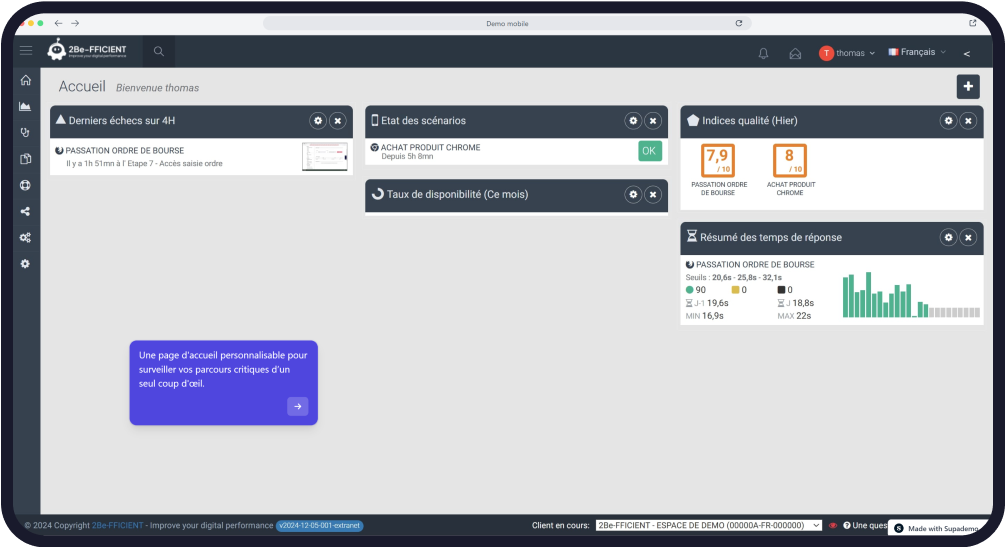
Real-time dashboards
Visualize all your performance and user experience data on customizable dashboards that can be shared with your teams.
How does it work?
Discover how 2Be-FFICIENT's API test monitoring and automation 2Be-FFICIENT comprehensive and transparent monitoring of your APIs.
API connection
Connect to the target endpoint and check its availability in real time.
Performance measurement
Calculation of response times to the nearest millisecond to identify network or server slowness.
- How long did it take my servers to respond to the request?
- Do I have bandwidth problems?
Automated execution
Regular API calls according to the frequency defined in your supervision strategy.
Analysis of responses
Detailed inspection of HTTP code, returned content, processing time and business rules.
Anomaly detection
Identification of errors, slowness or inconsistencies (incorrect payloads, timeouts, etc.).
Smart alerts
Generate enriched alerts, viewable from the console or sent via your own channels (e-mail, webhook...).
Approved and used by the largest companies
2Be-FFICIENT is deployed by leaders in the banking, insurance and e-commerce sectors.
Our customers rely on our technology to supervise thousands of API calls a day, guarantee the reliability of their integrations, and ensure impeccable quality of service.
API monitoring:
your questions, our answers
Can I monitor an internal or secure API, even if it's not publicly exposed?
Yes, our API monitoring solution supports restricted environments and APIs protected by advanced security mechanisms.
We have developed several secure integration methods, including client certificates (mutual TLS), authentication tokens and dynamic certificate retrieval from HSMs (Hardware Security Modules) such as Azure Key Vault.
This enables us to supervise internal API flows without compromising your security rules.
This capability is particularly useful for companies in the banking, insurance or any organization with stringent regulatory requirements (such as DSP2, RGPD, ISO 27001...).
How many APIs can I monitor with your solution?
Our monitoring infrastructure designed for complete scalability.
You can monitor a large volume of APIs - whether REST, SOAP or GraphQL - with no technical limitations on the number of endpoints.
Our customers use our solution to monitor both critical APIs (authentication, payment, data) and secondary APIs, to gain an overall view of the health of their information systems.
You can also configure several automated scenarios automated for the same API to track different use cases (e.g., authentication, account creation, transaction, consultation).
Do I need to install software to start API monitoring?
No, you don't need to install any agents or software components on your servers or infrastructures.
Our API monitoring operates from our hosted PLCs, which simulate external or internal API calls, just as a third party accessing your interface would.
This agentless approach enables rapid implementation, without modifying your existing architecture, and guarantees compatibility with hybrid, cloud or on-premise environments.
Do you offer an interface for viewing API test results?
Yes, all the data collected is available in a dedicated online console, accessible to your teams.
Here you'll find :
- Customizable dashboards
- Response time curves by endpoint
- A 13-month history to analyze availability and performance
- Enhanced alerts with error details, HTTP return code, response payload and execution time.
This interface provides a clear, usable readout, and facilitates exchanges between technical, product and support teams.
Can I create my own test scenarios for my APIs?
Yes. It is possible to modify the content of automated tests directly from the Extranet.
You can adjust parameters, headers or request bodies to suit your needs, without having to call on our support.
This flexibility means you can quickly adapt your scenarios to suit your specific use cases.
What alert options are available in the event of an API incident?
As soon as abnormal behavior is detected - server error, slow response, inconsistent content - an alert is automatically triggered.
These alerts can be configured according to your thresholds (e.g. code 500, timeout > 3s, empty response) and can be transmitted via several channels: e-mail, Slack, Microsoft Teams, webhook, etc.
Each alert is enriched by our embedded AI, Opale, with a context analysis, a reliability index and diagnostic elements to speed up processing by your teams.
What concrete benefits will I derive from API monitoring?
Proactive API monitoring allows you to :
- Drastically reduce mean time to detect incidents (MTTD)
- Identify performance degradation points before your users or partners are impacted
- Comprehensive traceability of your API exchanges
- Improve collaboration between DevOps, SRE, Product and Support
- Ensure consistent quality of service, especially on critical paths such as login, payment, third-party service calls or integration with external partners.
API monitoring: make your flows more reliable, protect your users
Monitor critical calls, detect anomalies invisible to conventional tools, and ensure the reliability of your routes with trusted third-party analysis.