Interactive voice server monitoring optimized for every interaction
Ensure the availability and fluidity of your interactive voice servers. Detect anomalies, reduce waiting times, and deliver a smooth user experience.
Limits of conventional IVR monitoring
Traditional monitoring of interactive voice servers focuses on availability and response times, but neglects a key element: the user experience.
- Insufficient analysis of malfunctions
- User frustration and impact on your image
-
Limited detection of malfunctions
linked to voice interactions
Interactive voice server monitoring focused on the user experience
Monitor the performance and availability of your
IVRs, while guaranteeing your users an optimal, seamless experience.
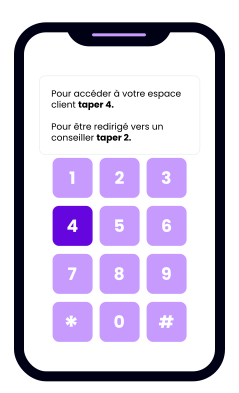
Complete DTMF management
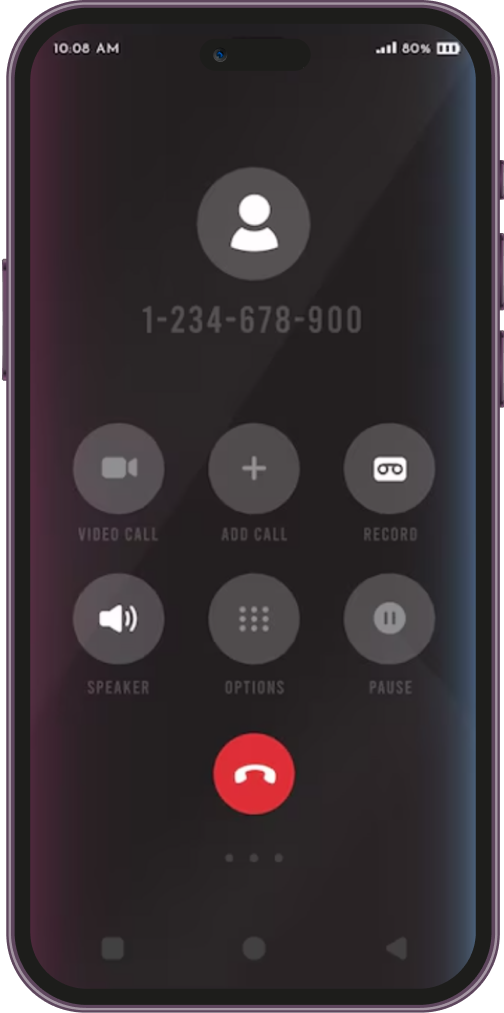
We simulate all DTMF inputs to faithfully reproduce your IVR paths. Whether using a real telephone for real-life conditions or an emulator, we cover all your needs.
- Real-life operating conditions (physical phones)
- Automated testing via emulator
- Faithful reproduction of user input
Voice response simulation
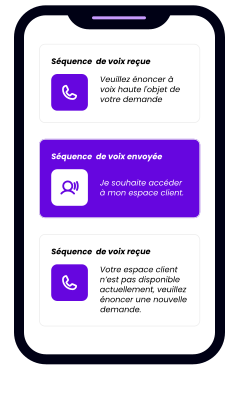
We simulate your IVR's verbal responses like a real user, and analyze exchanges in real time for immediate understanding.
- We talk to your IVR: automated voice responses to open-ended questions
- Audio-to-text conversion: instant transcription of conversations
- Error detection: analysis of malfunctions without audio equipment
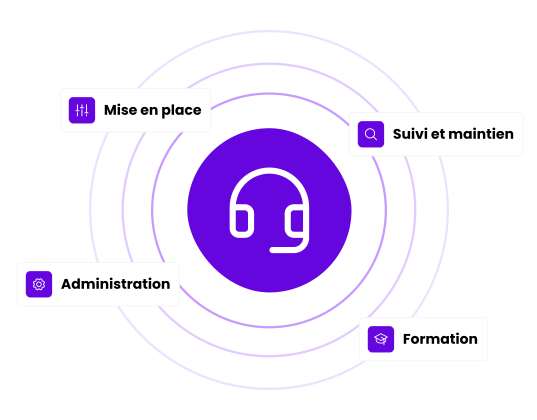
Dedicated customer support
At 2Be-FFICIENT, we fully administer the solution so you can focus on what matters most: improving the user experience!
- User path recording and tracking
- Responsive assistance for every request

- Tailored training for your teams
What our clients say
Whether you're using a single IVR or monitoring a complex system, our IVR monitoring solution ensures a smooth, uninterrupted voice experience.
Designed for an exceptional experience
Limits of conventional IVR monitoring
Continuous monitoring 24/7
Ensure a continuously optimal user experience with automated and proactive monitoring, replicating your users' actions at all times.
Define your key path
Select the critical steps of the user journey that you want to monitor continuously.
Automated scenario execution
Our robots exactly reproduce your users' journeys, simulating each interaction to detect invisible errors.
Immediate detection of friction
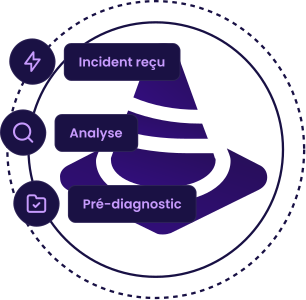
In the event of a problem (blocked form, excessive loading time, etc.), an alert is triggered with a precise pre-diagnosis.
Access to detailed and shareable data
Consult statistics and diagnostics directly from your dashboards, and easily share them with the teams concerned.
Analysis and rapid resolution
Use 2Be-FFICIENT's observations to correct points of friction and provide a smooth, frustration-free experience for your users.
Real-time alerts and preliminary diagnostics
Receive an immediate alert as soon as a problem occurs, accompanied by a diagnosis that helps you react quickly.
SMS
Push notifications
Voice alerts
SMS
Slack
Signal
Discord
Microsoft Teams
Slack
Signal
Discord
Proactive resolution of user friction
By identifying points of friction, 2Be-FFICIENT optimizes each path for a seamless experience.
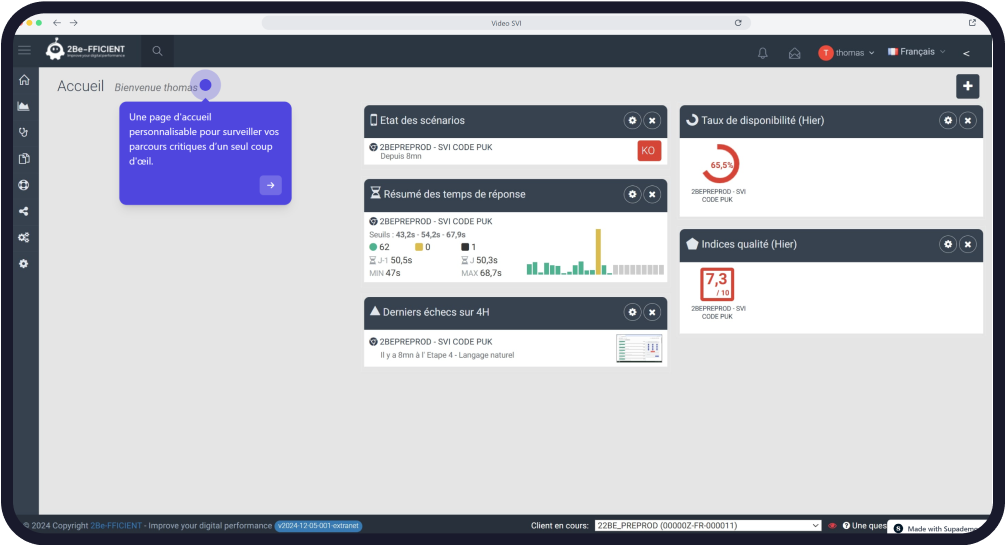
Real-time dashboards
Visualize all your performance and user experience data on customizable dashboards that can be shared with your teams.
How does it work?
Find out how 2Be-FFICIENT works for complete and transparent tracking of your users.
IVR access
Call the number and access the interactive voice server to start the journey. Select the critical stages of the user journey you wish to monitor continuously.
DTMF navigation
Use the phone keys to enter your choices and follow the proposed options.
Voice interaction
Speak a request aloud when required by the IVR to test voice recognition.
Stage validation
Check that each choice or answer leads correctly to the next stage of the course.
Achieving the final goal of the course
Transfer to an agent, obtain information or close the call.
Approved and used by the largest companies
For over 25 years, our technology has been used by companies in the banking, insurance, and e-commerce sectors.
Frequently Asked Questions
What sets 2Be-FFICIENT apart 2Be-FFICIENT other SVI monitoring tools?
Unlike technical monitoring tools that only check whether your IVR “hangs up,” 2Be-FFICIENT the entire voice journey just as a real caller would: DTMF navigation, voice responses, speech-to-text recognition, and transfer to an agent.
Three key differences:
- Real and emulated tests: calls made from actual physical phones AND via an emulator, to cover all scenarios
- Speech semantic analysis: real-time audio-to-text transcription to detect recognition errors
- Integrated pre-diagnosis: each alert specifies at which stage of the voice journey the issue occurred
On which platforms does 2Be-FFICIENT work, 2Be-FFICIENT does it require installation?
No installation or modification of your telephone infrastructure is required. Our automated systems call your IVR from outside your network, just as your customers would, without accessing your PBX or IT system.
What types of alerts are offered?
2Be-FFICIENT real-time alerts across all your channels: email, SMS, push notifications, Slack, Microsoft Teams, Signal, Discord, and voice alerts.
Each alert includes apreliminary diagnosis that precisely identifies the detected issue—such as an inaccessible voice menu, an unrecognized DTMF option, excessive wait times, or a failed agent transfer—so your teams can take immediate action.
Can I customize the IVR paths I want to monitor?
Yes, each scenario is fully customized based on your actual voice interactions. You define the critical steps: greeting, DTMF navigation, open-ended questions, transfer to an agent, obtaining information... and our teams record and maintain them for you.
You can also configurealert thresholds(acceptable response time per menu, test frequency) and combine IVR monitoring with your web or mobile journeys in an omnichannel scenario.
What is an interactive voice response (IVR) system, and why is it important to monitor it?
An Interactive Voice Response (IVR) system is an automated telephone system that greets callers, presents them with voice menus, and directs them to the appropriate department via DTMF tones or voice recognition. It is widely used in banking, insurance, and e-commerce to handle incoming calls 24 hours a day.
Monitoring it is essential because a failure or malfunction—such as a frozen menu, an unrecognized option, or a failed transfer—directly impacts your customers and causes immediate frustration. Unlike a website, an IVR error is often detected too late: customers hang up without reporting the problem.
How can you automatically test an IVR system without involving human staff?
2Be-FFICIENT fully 2Be-FFICIENT your IVR testing using two complementary technologies:
- DTMF simulation: Our automated systems dial your number and navigate through your voice menus by simulating keypad tones, just like a real customer
- Automated voice responses: For voice-recognition IVR systems, our bots provide the expected responses and analyze in real time whether the system has understood them correctly (speech-to-text)
These tests run every 5 to 10 minutes, 24 hours a day, using actual physical phones or emulators, without any human intervention.
Which industries need high-performance IVR monitoring the most?
The sectors where IVR is a critical customer service channel are the most vulnerable to system failures:
- Banking and insurance: card cancellation, filing a claim, checking account balances. A downed IVR system triggers an immediate customer crisis.
- E-commerce: order tracking, returns, customer service… traffic spikes (sales, Black Friday) put IVR systems under strain
- Energy and Telecommunications: Outage and Emergency Management via IVR… Any Outage Has Regulatory and Reputational Implications
For over 25 years, 2Be-FFICIENT major clients such as BNP Paribas, GMF, MAAF, MAIF, and Engie in their critical IVR initiatives.
Switch to IVR mtonitoring focused on your users
Offer your users a seamless experience: monitor every journey, identify friction points, and optimize before they affect your users.