Why is testing on real equipment essential?
When it comes to ensuring the quality and performance of a mobile application, mobile application testing is an essential step.
But the question often arises: should we use emulators or test directly on real mobile devices?
While emulators offer a quick solution for the early stages of development, they cannot faithfully reproduce real-life operating conditions.
In this article, we’ll see why monitoring on real mobiles is essential to guarantee a smooth user experience and optimal compatibility.

Tests on real devices vs. emulators: The major differences
Unrivalled realism and precision
An emulator is a computer program that simulates the behavior of a mobile device. But in reality, it is far from reflecting the experience of an end user.
Testing on real devices allows us to capture more precise data and gain a better understanding of an application’s actual performance.
Why is this crucial?
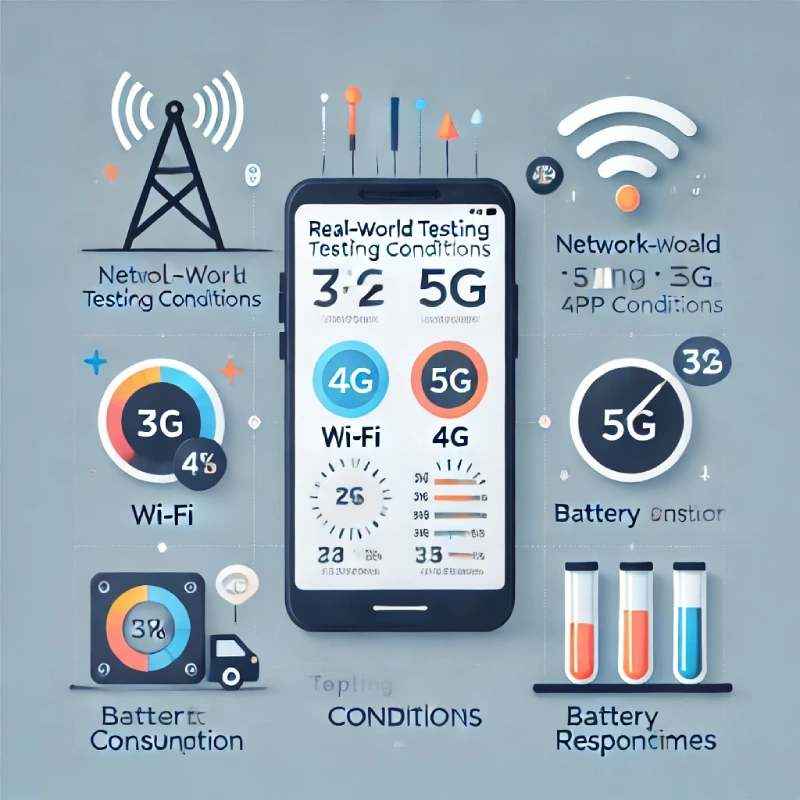
- Network fluctuations: In real-life conditions, users switch from Wi-Fi to 4G or 5G, which impacts application performance.
- Battery consumption: An emulator cannot be used to test the real impact of an application on the battery.
- Sensor management: augmented reality, GPS and gyroscopes don’t always work optimally on an emulator.
By testing on a real device, we ensure that the application reacts well to all these factors, offering an optimal, fluid user experience.
Better detection of hardware bugs
Every smartphone has unique characteristics: processor, sensors, screen size, Android or iOS version… These differences can generate specific bugs that won’t show up on an emulator.
For example, a bug may only appear on a phone model with a particular fingerprint sensor, or on a specific version of an operating system.
Testing on real devices allows us to detect and correct these problems before they affect end-users.
Variability of environments impossible to simulate
Smartphones are not closed environments: they are influenced by external factors such as installed applications, security settings and system updates.
An emulator doesn’t reflect this reality! It can’t simulate it perfectly:
-
Conflicts with other applications installed on the phone.
-
The influence of operating system updates.
-
User settings, such as adaptive brightness or battery restrictions.
By testing on several models of real smartphones, we ensure that the application is compatible with as many users as possible.
The concrete benefits of monitoring real mobiles
Detecting problems under real-life conditions
One of the greatest advantages of testing on real mobiles is the reliability of the results. Testing an application in real-life conditions enables us to measure :
✅ Network behavior as a function of signal variations.
✅ User interface fluidity as a function of processor and RAM.
✅ Charging times and the impact on the battery during prolonged use.
Support for sensors and hardware features
Some applications use advanced sensors :
- GPS for geolocation Camera for facial recognition Gyroscope and accelerometer for games and interaction
- Emulators cannot faithfully reproduce these interactions.
Testing on a real device therefore guarantees that all these features work as intended.
Performance and network connectivity tests
An application can be ultra-fast on Wi-Fi but completely slow on 3G.
Testing on a real mobile allows us to analyze : Latency during transitions between Wi-Fi and 4G/5G, the impact of a weak or intermittent signal, and error management and waiting times in the event of outages.
These points are crucial to delivering a seamless user experience.
How do you test your applications on real devices?
Best practices for optimizing your tests
To ensure optimum coverage, here are a few recommendations:
Use a wide range of smartphones (iOS & Android, entry-level and premium)
Simulate real-life scenarios (variable network connection, multitasking, airplane mode, etc.)
Perform prolonged tests to observe the impact on the battery
2Be-FFICIENT offers advanced monitoring on real mobiles, enabling :
✅ Continuous scenario execution
✅ Instant alert in case of anomaly
✅ Detailed reporting with precise insights
Testing your applications on real devices is essential to guarantee a smooth, bug-free experience.
Unlike emulators, tests on real smartphones deliver precise, usable results.
👉 Want reliable monitoring on real mobiles?
Contact 2Be-FFICIENT and find out how we can optimize the performance of your applications!