Measuring the performance of a mobile application
In the age of information technology, the routine use of software applications has become essential for most people. Every day, many new applications emerge, increasing competition in the marketplace.
Faced with this profusion, the distinction is no longer made solely on originality or functionality, but also and above all on mobile application performance. A successful application is one that not only meets technical standards of speed and reliability, but also offers an exceptional user experience.
In this context, it becomes essential to regularly measure and optimize performance, both from a technical point of view and in terms of user experience. Mobile application monitoring enables you to guarantee user satisfaction and the longevity of your application on the market.

1- The importance of mobile application performance
Mobile application performance refers to the speed and efficiency with which an application responds to users’ interactions and requests on their mobile devices. It encompasses several dimensions, from application start-up time to the fluidity of transitions and the responsiveness of buttons or touch gestures.
In a context where users expect instant answers, optimal performance is essential to guarantee a quality user experience.
It influences not only user satisfaction and loyalty, but also the app’s visibility on app stores like the App Store or Google Play. Indeed, better-performing apps often receive better ratings and reviews.
So mobile app performance isn’t just technical: it’s strategic, directly impacting user engagement, conversion rates and, ultimately, an app’s success in the marketplace.
It has become clear over the last few years that an application that takes longer than 1-2 seconds to respond can have adverse consequences, including lost sales and discouraged users of your application or site. Web performance, sometimes referred to as response time, is attracting increasing attention.
Today, monitoring the performance of your mobile application is of vital importance. Understand that the definition of success is not uniform, due to the significant variations between analysis tools and the various key performance indicators adopted by different teams.
An underestimated point
Regrettably, this concern is frequently underestimated, and many sites have load times that are uninviting to visitors. This may be due in part to the initial focus on content and functionality development. Lack of expertise is often a barrier to addressing this issue.
Another key point to emphasize is the tendency to blame performance problems primarily on the server or infrastructure, when the real cause is far more complex and requires in-depth analysis to resolve.
A. Performance measurement tools
Accurately measuring the performance of a mobile application is essential to guaranteeing an optimal user experience. In a world where user retention is directly linked to the quality of the app experience, it’s crucial to have a clear view of your app’s performance. Fortunately, there are a multitude of tools dedicated to this purpose. These tools, often integrated into comprehensive analysis suites, enable developers and QA (Quality Assurance) teams to monitor, test and optimize the performance of their applications in real time, while analyzing relevant data.
- Profiling and Debugging: Tools such as Android Profiler (for Android applications) or Xcode Instruments (for iOS) offer detailed insights into the application’s use of resources, such as memory consumption, CPU usage and network traffic. These tools are essential for understanding how the application performs on different devices and screens.
- Performance testing: Platforms such as Appium or Espresso enable automated performance testing, simulating real-life usage scenarios to assess how the application behaves under different conditions. These tests are crucial for measuring performance KPIs and ensuring that the app meets user expectations on web and mobile.
Here is an overview of the tests that can be carried out:
- Performance testing is crucial for web applications to ensure they run at peak performance. These tests evaluate various parameters such as response time, number of simultaneous users and transaction volume.
- Load tests analyze the software’s behavior when faced with an increase in workload, while endurance tests evaluate its performance over an extended period of time.
long period.
- Resistance testing, on the other hand, pushes the software beyond its usual limits to assess its stability.
- State-of-the-art tests examine the software’s responsiveness to sudden spikes in load,
- Volume tests evaluate its performance with large quantities of data,
- And finally, scalability tests examine its ability to handle constantly evolving workloads.
-
Real-time monitoring: 2Be-FFICIENT ‘s solution stands out for its real-time monitoring of mobile application performance. Using real mobile devices, coupled with various browsers and operating systems, their automata faithfully reproduce user behavior. This approach makes it possible to monitor the availability and performance of applications, ensuring smooth browsing for customers. In the event of a malfunction, whether a failure or a simple slowdown, 2Be-FFICIENT ‘s system sends alerts in real time, with pre-diagnostics enabling teams to resolve problems before they become critical. This proactive monitoring guarantees an optimal user experience, boosts sales for e-commerce applications, and in all cases strengthens the corporate image.
-
User feedback: Application stores, such as Google Play Store or Apple App Store, offer valuable feedback from users, which can often point to performance problems. What’s more, tools like Instabug or Appsee can collect direct feedback from users, including videos of usage sessions, to identify performance issues and improve the overall experience.
-
Crash analysis: Platforms like Crashlytics help to identify, track and resolve problems that cause application crashes, providing detailed information on crash conditions.
The combined use of these tools gives development teams a holistic view of their applications’ performance, from code optimization to the final user experience. By constantly analyzing data and carrying out regular tests, they can guarantee a fast, reliable and user-friendly application, whatever the device or screen used.
To understand why testing on real devices is essential for reliable evaluation, read our article on mobile testing and emulators.
B- Key performance indicators (KPIs)
You’re confident in the design quality of your mobile app and its ability to meet the needs of your target audience, but you’re wondering why it’s essential to track key performance indicators.
The answer is simple: the successful design of the specification, involving users, and the launch of the application on the stores are not enough to guarantee its use. The application must be discovered by the target users, arouse their interest, and encourage them to download it. This is where mobile SEO comes in. Even if your app is well received at launch, there’s no guarantee that this positive impression will last over time.
Your job doesn’t end when the mobile app goes live. Maintain user engagement and track key performance indicators (KPIs) to measure this engagement from the moment the app is launched on the stores, and to monitor its evolution throughout its lifecycle. Which KPIs should you track?
I. Number of downloads
Developer analytics tools, such as Apple’s Apps Analytics or Google’s Developer Console, provide various statistics, including the number of downloads of an app. If you’ve defined a download target and a timeframe for reaching it, you should track this KPI. This will enable you to assess the impact of future application updates.
II. De-installation rates
Mobile app users are demanding and impatient. According to a recent report, a large proportion of applications are uninstalled shortly after downloading. Keep an eye on this KPI, as it indicates how quickly users disengage. A high rate of uninstallations suggests potential problems. It’s important to understand when these uninstallations occur. User comments on blinds can provide clues to potential problems.
III. Number of mobile application crashes
Application crashes, caused by technical malfunctions, are frustrating for users and can lead to their uninstallation. Application analysis tools provide data on crashes, an important KPI to monitor. It is vital to identify the source of these crashes.
Be aware that a mobile application can accumulate technical debt if it is not regularly updated to take account of changes in operating systems, libraries and frameworks. This technical debt can lead to crashes.
IV. Session duration
This KPI corresponds to the average length of time users stay in the application, from opening to closing. A longer session duration generally indicates greater user interest in the application. This KPI needs to be analyzed with caution, as it can vary depending on the type of application. Some applications can be very useful for users, even if the average session length is short. If your application offers a lot of content, it’s logical that sessions will be longer.
If the average session length doesn’t meet your expectations right from the start, or decreases over time, it’s important to look for potential causes, such as friction points in the user experience, or a possible lack of user interest in the application.
V. Average interval between 2 sessions
This indicator measures the average time between two consecutive sessions of the same user on the mobile application. If this period is gradually increasing, it’s important to question the underlying reasons. Does it reflect a decline in interest in the application? Perhaps latency problems or bugs have arisen? Analysis of user feedback can be invaluable in shedding light on this trend.
This performance parameter allows you to divide your audience into segments according to how often they use the application (occasional users, regular users, etc.). You might consider soliciting less frequent users through satisfaction surveys, to discern any obstacles to more consistent use of the application.
VI. Average number of screens viewed per visit
Unlike the previous KPI, a high number of screens viewed per visit is an indicator of application quality and user interest. It implies that the user journey is probably well designed and that navigation is easy. If this number declines over time, it is necessary to investigate the reasons for this evolution.
VII. Number of active users per day or month
Active users are those who launch the application and interact with it on a daily basis (or at a specific frequency, e.g. once a week or once a month). The aim is to ensure that this number grows steadily, or at the very least, doesn’t decrease.
It would be a good idea to analyze the behavior of the most active users to identify the pages or features that hold their attention. For less active users, it might be a good idea to encourage them to explore the application further, whether through push notifications or e-mail satisfaction surveys. This represents a valuable opportunity to improve the user experience.
VIII. Drop-out rates
As with the previous indicators, it is essential to monitor the evolution of the abandonment rate over time. An increase in this rate is an alarm signal. It can reveal potential problems concerning the health of the application, or a declining user experience. It is imperative to quickly identify the precise points at which users abandon the application, in particular the screens where this occurs, and to carry out an analysis of the underlying reasons for these desertions.
IX. Loading times
The slower the application, the harder it is to keep users engaged. Slowness and performance problems are among the main causes of loss of interest. For example, abandonment of a particular feature may signal excessive latency.
2- Performance from a user experience perspective
The performance of an application is not limited to its technical aspects. User experience and feel play an equally crucial role. An application may be technically perfect, but if it doesn’t meet users’ expectations and needs, it will be perceived as underperforming.
Ease of use : An intuitive interface and a smooth user experience are essential. If users have difficulty navigating or completing specific tasks, this can affect their overall perception of the application’s performance.
User satisfaction: Gathering feedback from users, whether via surveys, comments or evaluations, can provide valuable information on how they perceive the application’s performance. Recurring negative reviews on specific issues may indicate areas requiring attention.
Adaptability: An application’s ability to adapt to different devices, screen sizes and orientations is essential to ensure a consistent user experience. An application that doesn’t adapt properly can be perceived as underperforming, even if it works technically well.
Ultimately, an application’s performance is a combination of its technicality and the way it meets user expectations. Developers and product management teams therefore need to adopt a balanced approach, taking into account both technical indicators and user experience.
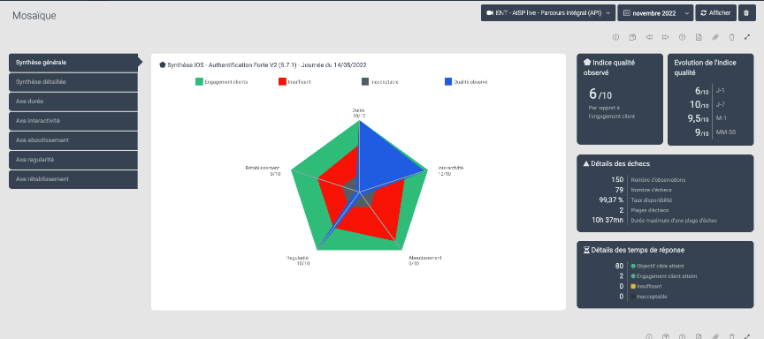
2Be-FFICIENT methodology combines technical performance and user experience for your mobile applications
Optimize your users’ experience by monitoring the performance of your mobile application with 2Be-FFICIENT’s invaluable help.
We become your trusted partner in mobile application monitoring, ensuring an impeccable user experience. Our approach uses authentic mobile devices combined with a variety of browsers and operating systems, enabling our automata to perfectly reproduce mobile user behavior. This allows you to monitor the availability and performance of your applications in real time, guaranteeing a smooth browsing experience for your customers.
In today’s digital environment, a high-performance mobile application is essential to ensure a smooth user experience and maintain a positive brand image. At 2Be-FFICIENT, we are fully aware of the importance of monitoring your application’s performance in real time. That’s why we’ve developed a mobile application monitoring service that enables you to quickly detect problems before they affect your users.
Advantages of 2Be-FFICIENT
- A monitoring solution focused on the user experience.
- Constant real-time monitoring of your application’s performance, providing instant information on how it’s running.
- Proactive identification of malfunctions thanks to our proactive monitoring technology, enabling the detection of slowdowns or malfunctions before they impact your users, giving you the chance to resolve them quickly.
- The guarantee of a fluid user experience thanks to the smooth running of your application, promoting user satisfaction and consolidating your brand image.
- Proactive monitoring that doesn’t just react to problems after the fact, but anticipates them by constantly monitoring your application’s performance, because slowdowns are often the harbingers of more serious problems.