Challenges and issues
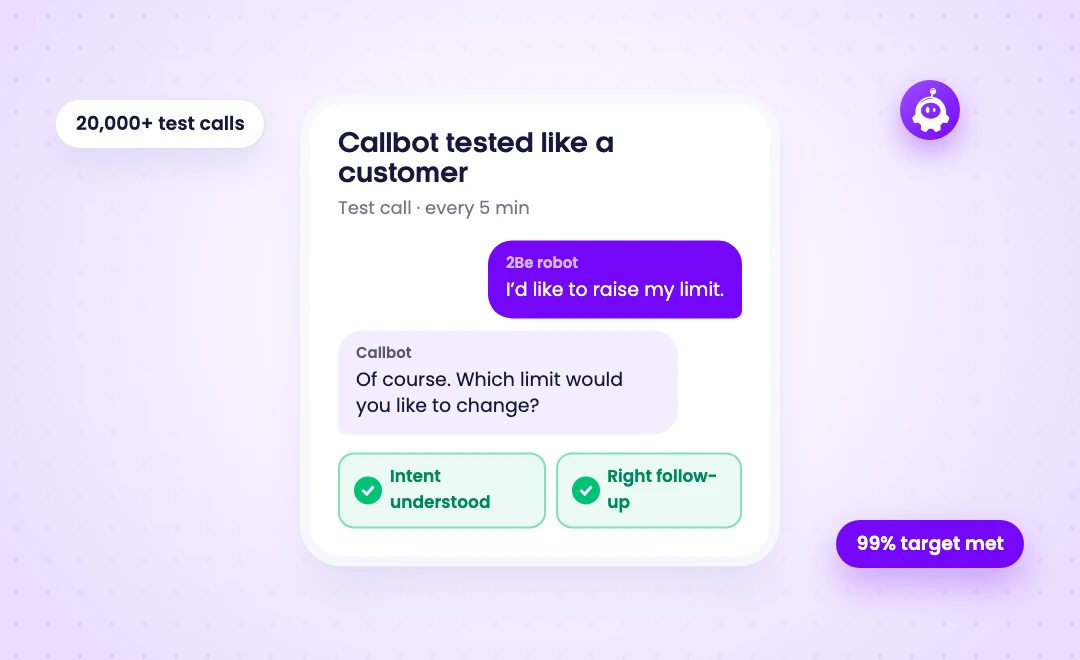
A natural-language callbot cannot be checked by its availability alone: it must understand what the caller says and ask the right question. It therefore has to be tested like a real customer: a sentence spoken out loud, an intent understood, an expected follow-up question. And when a failure occurs, the team concerned (telephony, banking information system, callbot vendor) must be alerted directly.
Solution implementation
Three journeys are called every 5 minutes: more than 20,000 test calls over the measured period, for availability above 99%. The greeting is measured from the same call as the identification: one call, two separate indicators.
Functional coverage
- The greeting and the welcome message
- The identification of a personal customer, up to the identification step
- A callbot journey: the caller asks to raise a limit, and the robot must understand the intent and then ask the right follow-up question (“which limit?”)
Results (over the measured period)
- The callbot meets its 99% target.
- The identification journey is the most fragile: it sits just below the 99% target.
- On identification, 30% of failures occur at a single menu, the account inquiry menu: a precise point to fix, not an “unstable” IVR in general.
- Failures recur on several nights: a possible maintenance window, to be confirmed.
- The client has taken ownership of the tool: it creates its own alerts and mutes the failures it considers irrelevant.
Target: 99% availability
The identification journey is the most fragile
Conclusion
A callbot is tested like a real customer, and the failure is located to the exact step, so that the team concerned is alerted directly. A short test call is enough to produce figures fit for a steering committee.