Launching a digital service isn’t a leap in the dark
Each deployment involves risk. The moment a release is launched, a single undetected anomaly can trigger a cascade: technical errors, slowness, lost conversions, social media frenzy, etc.
And in a world where user experience is king, this kind of failure is costly – in brand image, revenue, and pressure on teams. That’s why pre-production monitoring on the web or mobile is becoming an essential strategic lever.
So why do so many companies still regard pre-production as a mere intermediate stage, rather than as a truly critical environment to be monitored?
At 2Be-FFICIENTwe’ve worked with dozens of major companies on their digital journeys - from websites and mobile applications to voice services. And what we’ve observed is clear: pre-production environments are often the missing link in truly proactive supervision.
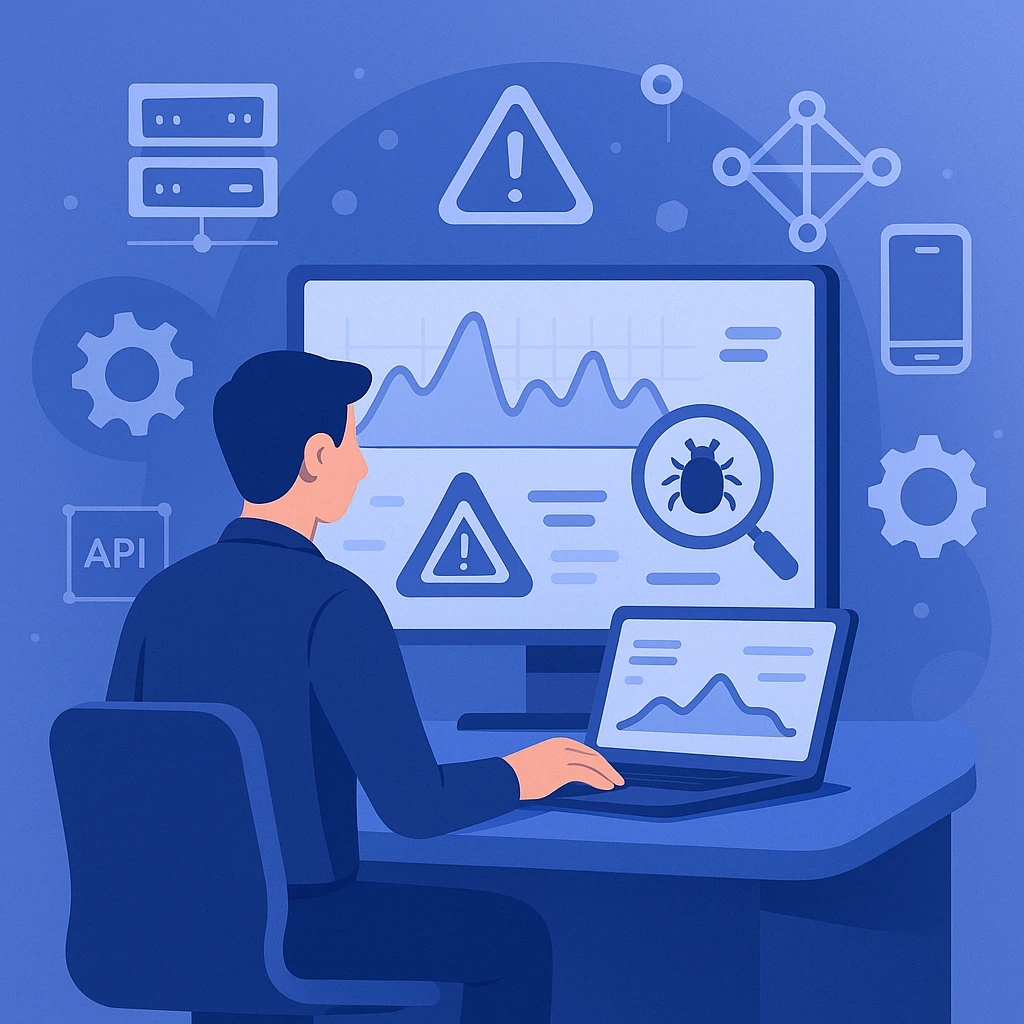
Pre-production ≠ sandbox
Pre-production is often perceived as a “pretty clean” space, intended for manual validation or rudimentary automated testing.
But in reality, it’s the last bastion of prevention before user impact.
Three truths about pre-prod:
-
This is where all the uncontrolled variables converge: hybrid versions, unstable API calls, non-replicated configurations.
-
This is often the environment closest to reality, without the constraints of production (such as log restrictions or intrusive monitoring).
-
and yet very few organizations have any serious pre-production monitoring in place.
Why is pre-production monitoring a strategic lever?
-
Because users don’t forgive.
Web or mobile, digital services have become critical. Users expect constant availability, fluid navigation and optimal response times. The slightest bug or slowdown can lead to uninstallation, lost shopping baskets or complaints.
A crash under certain browser conditions? A regression that escapes manual testing? An API call blocked only in a specific environment? These are the kinds of errors that could have been detected in pre-prod… if you were monitoring properly.
At 2Be-FFICIENT, we offer the possibility of simulating user journeys on real browsers and physical terminals. As a result, our customers catch anomalies that are invisible to conventional tests, long before they reach their users.
-
Because classic test scenarios are too rigid.
Automated QA generally covers what’s expected. But it’s often unanticipated behavior, external latencies, load increases or slow degradations that create the real incidents.
Our customers use dynamic supervision scenarios, designed to run continuously on their pre-prod environment, simulating the key actions of their end-users:
- Connection
- Navigation
- Add to basket
- Customer area consultation
- Finalize form or payment
- All measured in real time, 24 hours a day, with alerts as soon as an abnormal threshold is crossed (response time, step failure, sequence break…).
-
Because pre-production is often less restricted than production
In many cases, the tools installed in production are subject to severe constraints (RGPD, weight of scripts, bandwidth…). As a result, we don’t dare measure everything.
In pre-production, on the other hand, barriers come down. We can inject more diagnostic tools, simulate volumes, trace every server call, or observe the precise behavior of a CSS, JS or API element.
And all this without impacting the actual user experience.
At 2Be-FFICIENT, that’s where our embedded AI Opale comes in. It analyzes discrepancies between expected and observed behavior, identifies latent errors, qualifies relevant alerts, and helps teams prioritize what really matters.
Case study: avoiding an incident by detecting a regression in preprod
Let’s take the example of an e-commerce player. Before updating its order tunnel, the team decides to monitor its pre-prod environment with 2Be-FFICIENT.
A scenario detects that under certain conditions, a call to the third-party delivery service fails silently, preventing order validation. The error does not show up in classic QA.
Thanks to the diagnostic video, network log analysis and full replay of the scenario, the team identified poor exception handling in the frontend code.
Result: corrected before going live. Zero user impact.

What are the concrete benefits of pre-production monitoring?
Perceived quality depends on stability and performance at every moment of the user journey. Google also makes it an explicit criterion in its Core Web Vitals, which impact both experience and natural referencing.
Here are the benefits observed by our customers after implementing pre-production monitoring:
| Profit | Explanation |
| Reducing post-production incidents | Fewer bugs visible to users = better satisfaction and image |
| Improved digital stability | Scenarios run under real-life conditions (browser, OS, device) |
| Savings on media | Fewer tickets, fewer escalations, fewer crisis meetings |
| More informed decisions | Real performance data from the pre-prod phase |
| Improved QA / Dev / Support collaboration | Defects qualified and ready to be resolved faster
|
Thanks to well-designed pre-production monitoring, incidents are detected in a realistic environment before they affect real users.
What does 2Be-FFICIENT offer for web and mobile pre-production?
We have designed our solution to meet these specific challenges:
- 24/7 monitoring of user scenarios on real browsers or physical terminals
- Adjustable recurrence, typically every 10 minutes
- Intelligent alerts, sent only when abnormal behavior is repeated
- Diagnostic console with captures, logs, videos, network analysis
- Total customization of scenarios: authentication, navigation, business errors, etc.
- No client-side installation: tests are performed remotely and transparently
And now, with the integrated Opale AI, our customers save time in analyzing and qualifying anomalies. It filters out false positives, detects unusual patterns, and enables finer prioritization of problems.
In short: prevention is better than urgent correction…
Monitoring pre-prod is not an unnecessary expense. It’s proactive quality assurance, anticipating problems where they can still be painlessly corrected.
Pre-production monitoring allows you to identify what traditional QA testing misses, and to act in time to avoid a risky release to production.
In a world where deployment cycles are accelerating and users are less and less tolerant of error, ignoring pre-production means exposing yourself.
Need to audit your pre-prod environment?
At 2Be-FFICIENT, we offer a free personalized diagnosis, with the implementation of a monitoring scenario on your pre-production web or mobile environment.
You’ll see, or rather know, what you weren’t detecting.
Contact us to discuss it: /contact/