The buying journey, also known as the buyer journeyrepresents the path followed by a prospect from the recognition of his or her need to the decision to buy.
Digital marketing is evolving rapidly, and understanding the consumer buying journey is essential. Whether you’re in charge of e-commerce, CIO or user experience, this guide is for you.
Find out how each stage, from awareness to decision, can transform a hesitant prospect into a loyal customer, and how to set up an optimized customer journey thanks to monitoring.
1- Introduction to the buying journey
Understanding this journey is of vital importance in developing an effective marketing strategy, as it highlights a prospect’s consumption behavior, from the very first moments through to customer status. This approach enables us to identify the key stages where online content, information and opinions have a significant influence on the consumer’s purchasing decision, helping to improve the quality of the products or services on offer and increase sales.
The success of marketing actions depends on understanding this path. To analyze the buying journey and transform a prospect into a customer, we need to define the buyer persona.
Defining the buying path
The buying journey encompasses all the stages a prospect goes through to become your customer. It comprises several points of contact, each with a specific objective, and represents the entire process leading up to the act of purchase.
It’s important to distinguish between the purchase journey and the customer journey. In fact, the purchase path is one part of the customer journey, which encompasses all the steps following the purchase, such as customer service in the event of a problem, satisfaction surveys and customer recommendations via reviews, for example.
The importance of the buying journey for companies
The importance of the buyer’s journey for businesses cannot be underestimated, as it focuses on the prospect, unlike the sales tunnel, which focuses primarily on the salesperson.
By fully understanding the buying journey, companies can identify the friction points encountered by their prospects and adjust their outbound sales strategies to better meet their needs. The ultimate goal is to analyze buying behavior at every stage of the process, in order to optimize the customer experience.
By ensuring that the journey is personalized at every touchpoint and consistent across all channels, companies not only make it easier for consumers to find products or services, but also make the journey more enjoyable. It’s essential to restore satisfaction to the buying experience, as this will encourage customers to return, especially at a time when the cost of acquiring new customers is constantly rising.
2- Key stages in the purchasing process
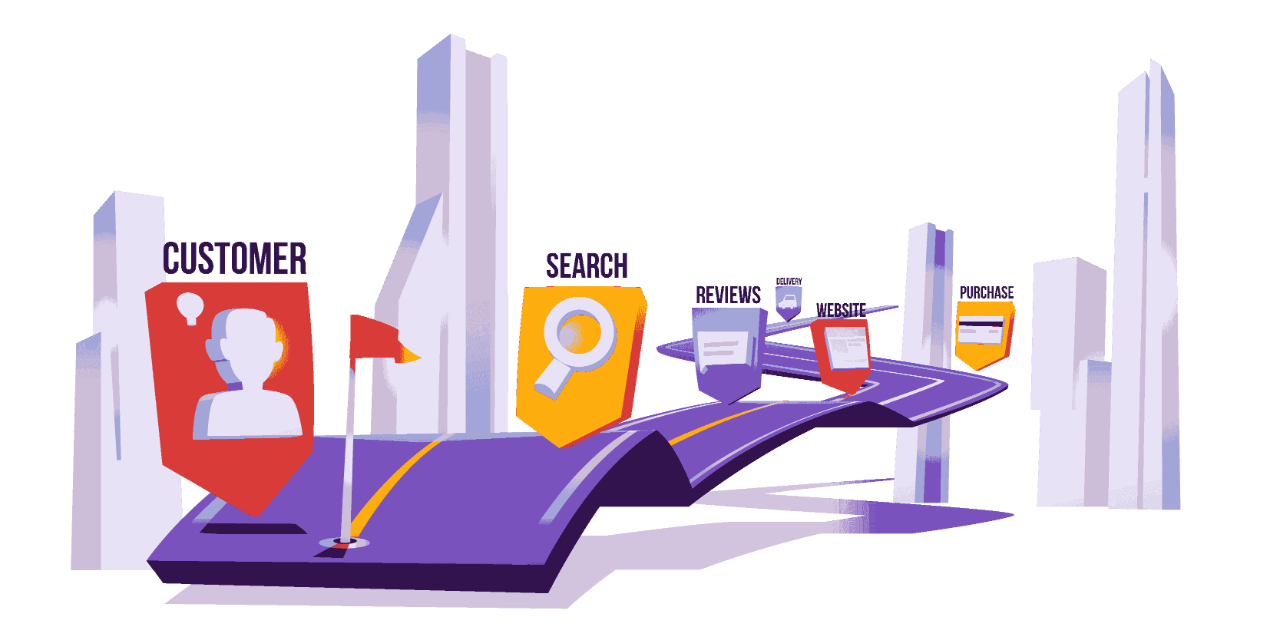
In the vast landscape of the buying journey, punctuated by multiple phases of reflection and decision-making, three stages in particular stand out, shaping prospects’ path to acquiring your product or service: awareness, consideration and decision.
A - Awareness
The awareness phase represents a crucial moment in the consumer’s buying journey, marking the beginning of their search for solutions to unmet needs. It occurs when the consumer identifies a gap or an unfulfilled desire.
To answer this quest for information about their needs, your audience turns to a variety of content such as blog articles, studies or educational books. It’s imperative for your company to be present at this first stage of your target audience’s buying journey.
By providing neutral, objective information on your website, your company positions itself as an authority in its field. This keeps your brand fresh in the minds of consumers.
B- Consideration
After awareness comes the consideration phase, another key moment in the buying process. It’s at this stage that your audience assesses the different options available to meet their needs, and compares your offer with those of your competitors.
To entice these consumers to make a purchase, it’s essential to provide them with concrete content. Content marketing becomes a powerful tool, with product comparisons, customer testimonials and case studies to highlight your offers.
Customer reviews play a crucial role at this stage. Indeed, 92% of French people admit to consulting online reviews before choosing a company for a purchase or service.
The consideration phase is vital for your company, as it’s at this point that the consumer comes closer to making his final decision. You absolutely must be present in the right place to be taken into account in their thinking.
C- Decision
This is the decision stage. Your prospect is ready to make a purchase, and must now choose between the various offers he has identified as meeting his needs and expectations.
This is the time to highlight the competitive advantages of your product or service. You need to focus on highlighting your strengths.
To support your prospects favorably at this stage, content sharing remains essential. Customer testimonials, product demonstrations and free trial offers are all differentiating elements. Reviews, in particular, can reassure Internet users about any hesitations they may have. A large number of positive comments demonstrating customer satisfaction can reassure them in their decision to work with you.
3- Strategies for optimizing the buying journey
Lhe move towards omnichannel communication has made optimizing the customer journey more complex. For a buying journey without seamlesschoose 2Be-FFICIENT ! Today’s buyers can access your company via a multitude of channels: web search, social networks, e-mailcontent on your company blog, articles in the media, instant messaging, and even discover your physical points of sale. At each of these entry points, it’s crucial that the customer experience is impeccable.
A - Personalizing the customer experience
Personalizing the customer experience means tailoring every interaction with customers to their individual needs, offering a bespoke experience at every stage of the customer journey. This approach is essential, as it enables companies to stand out from the competition by offering superior service, and helps them to better understand their customers, enabling them to respond more effectively to their needs and build loyalty.
This personalization can take many forms, from simply greeting a customer by their first name in an e-mail, to a promotional offer tailored to their buying habits, or even a birthday gift. These little touches all contribute to strengthening the bond between your customers and your brand.
C- Optimizing contact points
To guarantee an optimal customer experience, companies need to continually evaluate and improve their customer interactions. This includes identifying problem areas in order to improve the overall customer experience. For example, analyzing user behavior on the website can detect potential problems and optimize navigation to boost conversions. Similarly, effective management of customer support, monitoring response times and satisfaction levels, is crucial to pinpointing areas for improvement, such as staff training or the integration of chatbots for faster responses.
Social networks also offer a platform for strengthening ties with customers by adjusting strategy to create more engaging content and reinforce brand presence. Finally, a focus on the post-purchase experience, with real-time order tracking and updates, helps to increase customer satisfaction and encourage repeat purchases. By focusing on optimizing these interactions throughout the customer journey, companies can deliver a consistent and rewarding customer experience, fostering loyalty and long-term business growth.
D- Analysis and continuous improvement
In an ever-changing world, continuous improvement is essential to maintain a company’s competitiveness. By regularly evaluating and refining business processes, companies can adapt to changing customer needs, improve operational efficiency and ensure long-term growth.
Continuous improvement means constantly evaluating existing methods, with the aim of optimizing productivity, simplifying operations and meeting ever-changing business requirements. It’s a dynamic process that requires ongoing commitment to deliver an exceptional customer experience and maintain a competitive edge.
3- Tools and technologies for analyzing the purchase path
With the proliferation of distribution and communication channels, tracking the customer journey represents a major challenge. Consumers juggle social networks, websites and various devices, making it difficult to keep track of them. To adjust to customers’ ever-changing needs, you need to adapt to their behaviors. Fortunately, UX analytics tools simplify this task by providing a clear overview of the customer journey.
With the proliferation of distribution and communication channels, tracking the customer journey represents a major challenge. Consumers juggle social networks, websites and various devices, making it difficult to keep track of them. To adjust to customers’ ever-changing needs, it’s crucial to adapt to their behaviors. Fortunately, UX analytics tools simplify this task by providing a clear overview of the customer journey.
A- Data analysis and CRM
Analysis of CRM (Customer Relationship Management) analysis plays a fundamental role in this strategy. By taking an in-depth look at customer data, it enables us to better understand their expectations and adapt and adapt customer management accordingly. Marketing automation also represents a solution for optimizing communications and operational processes. This technology makes it possible to personalize customer interactions and efficiently track their journey, from the creation of automated from the creation of automated e-mails to advertising targeting and A/B testing. By combining these tools, companies can improve their understanding of customers’ needs and respond to them throughout their purchasing journey.
B - Marketing automation
Marketing automation is the use of software to manage customer communications and operational processes, freeing marketers from time-consuming tasks. This approach is particularly effective for small businesses, enabling them to implement their strategy without mobilizing significant resources. It works best when an audience is already established, but is also an effective way of attracting new customers and generating leads.
For example, marketing automation software can analyze the performance of an advertising campaign and adjust parameters accordingly, avoiding the need for manual customer follow-up. By integrating features such as ad retargeting, A/B testing and automated e-mails, your strategy can be optimized to communicate effectively with customers at every stage of their journey with your company.
C - Proactive monitoring of purchasing paths for a 360° view
To optimize the digital purchase path, it is essential to implement a user path monitoring tool. 2Be-FFICIENT is the monitoring solution that locates weak points in the buying path and alerts the relevant teams in real time with a precise pre-diagnosis, facilitating rapid and effective intervention.
One of 2Be-FFICIENT ‘s key strengths is its proactive approach. Rather than reacting to
problems after the fact, this tool ensures continuous monitoring, and contributes to better optimization of the user experience.
Using 2Be-FFICIENT, companies can not only quickly identify potential obstacles in the buying journey, but also adjust their strategies in real time to deliver a smoother, more satisfying customer experience. This approach improves sales performance while enhancing customer satisfaction and loyalty.
This tool fits perfectly into an overall customer journey analysis strategy, complementing other technologies such as CRM and marketing automation. It offers a clear and coherent overview of consumer behavior, enabling companies to adjust their actions in line with their customers’ needs and expectations.
In short, 2Be-FFICIENT is a powerful solution for any company wishing to proactively monitor the digital buying journey, improve the user experience and increase customer satisfaction.