By closely examining its performance, features and user experience, this evaluation provides valuable data for optimizing the application and effectively meeting user needs.
The importance of performance for mobile applications
In today’s digital age, mobile applications have become indispensable for making daily life easier. With the profusion of options available on the market, competition is intense. Performance is a crucial element in ensuring the success of an application among this plethora of options.
Consequently, it is essential to constantly monitor the performance of your applications in order to remain competitive and meet user expectations.
Impact on user experience
The performance of mobile applications is of paramount importance, having a direct impact on the user experience. So when developing and optimizing an application, it’s crucial to monitor elements such as page loading speed, responsiveness of interactions and fluidity of animations.
Any slowdown or malfunction may not only irritate users, but also discourage them from using the application.
Impact on customer loyalty
Application performance also influences customer loyalty. Increased user engagement generally translates into more frequent use of the app, reducing the risk of users switching to the competition.
By offering a fluid, responsive user experience, you can boost user loyalty and consolidate your position in the mobile app market.

Key performance indicators to monitor
Performance criteria within a company are diverse and often developed according to the SMART principle (specific, measurable, achievable, realistic and time-bound). These indicators are designed to assess the organization’s operational efficiency and effectiveness.
When it comes to mobile applications, certain key performance indicators are crucial to ensuring optimal user experience and stable performance. Here are the main ones to keep an eye on:
Response times and availability
Response time
Response time measures how quickly the application responds to user actions. Fast response times are crucial to maintaining user engagement.
High latency can lead to frustration and higher uninstall rates. Tools are available to monitor these response times in real time, providing valuable data for optimizing application performance.
Availability rate
Uptime is a critical indicator of an application’s reliability. It represents the percentage of time during which the application is operational and accessible to users.
High availability is essential to ensure that users can access the application whenever they want.
Monitoring services provide detailed information on application availability, enabling downtime problems to be quickly detected and resolved.
Number of failures
Crashes and errors
Application stability is a key factor in ensuring a good user experience. The number of crashes and errors should be minimized as far as possible.
Regular bug tracking with a tool like 2Be-FFICIENT helps to identify the causes of these failures and make the necessary adjustments.
Location of weak points
User path analysis
User path analysis helps identify weak points in the application. By tracking user interactions, it’s possible to pinpoint which sections of the application are causing abandonment or errors.
Some solutions provide detailed insights into user behavior, enabling problem areas to be optimized.
Loading time
Fast screen loading
Screen loading speed plays a crucial role in user retention. Too long a loading time can lead to a higher bounce rate.
Regular technical audits are essential to identify slowing factors. Tools such as PageSpeed Insights or Lighthouse offer practical recommendations for improving screen loading speed, contributing to a smoother user experience.
Resource consumption
Optimizing resources
Optimizing resource consumption is also a key performance indicator. This includes memory management, battery consumption and data usage.
An application that consumes too many resources can be uninstalled by users. Tools such as Android Profiler or Instruments on iOS can monitor and optimize resource consumption, contributing to better overall application performance.
User satisfaction
User reviews and ratings
Reviews and ratings left by users on application stores are direct indicators of satisfaction. Regular analysis of feedbacks enables us to understand the application’s strengths and weaknesses from the user’s point of view.
Responding to criticism and implementing improvements based on user feedback are essential to continuously improve the experience.
Frequency of use
Commitment and retention
Frequency of use and retention rates are key indicators for measuring user engagement. A high retention rate indicates that users find value in the application and return regularly.
Analysis tools such as Mixpanel or Amplitude help track these metrics and understand user behavior, enabling retention strategies to be adjusted.
By monitoring and optimizing these key performance indicators, companies can guarantee a high-quality user experience, improve the stability and reliability of their mobile application, and ultimately increase user engagement and satisfaction.
How do you measure performance effectively?
To ensure effective evaluation of results, it is essential to define clear objectives, collect relevant data, carry out regular analysis, identify key success factors, and take corrective action where necessary.
The success of a digital marketing strategy depends on the judicious selection of key performance indicators (KPIs) in line with your company’s precise objectives. For qualitative qualitative app performance metricsturn to 2Be-FFICIENT.
Measurement tools and techniques
Measuring website performance involves a number of practical techniques. Page load time is crucial to a satisfactory user experience, while bounce rate measures the number of users leaving the site after visiting a single page.
HTTP request analysis examines the number of requests needed to load a page, while reducing the size of files such as images and scripts can improve overall site performance.
Evaluating website performance is essential for digital marketers, and there are several tools at their disposal. Here is a selection of commonly used techniques:
Analyzing the loading speed of a web page involves checking parameters such as loading time, server response time (TTFB), DOMContentLoaded and time taken for the page to become interactive (TTI). This data enables us to understand the user experience and identify areas for improvement. In addition, it is useful to assign a speed score to the page and provide detailed recommendations for resolving performance problems.
Evaluating the performance of two web pages enables you to compare their performance and identify areas for improvement. In-depth performance analysis, together with practical tips for optimizing site speed, facilitates continuous improvement.
Performing speed tests from different locations is particularly useful for evaluating site loading speeds in different parts of the world. This can have a significant impact on the user experience. By providing reliable and accurate test results, this approach enables digital marketers to effectively optimize website performance.
Evaluating a website’s load speed from various locations around the world and obtaining detailed site performance data, such as load times, page dimensions, HTTP requests, and other significant indicators, enables users to fully understand their site’s performance. In addition, it is useful to offer advanced features such as slow connection simulation and compatibility with different browsers, providing a comprehensive assessment of site performance.
Interpreting data to make decisions
Once the data from a mobile application has been collected, it must be analyzed to extract relevant information. This analysis enables the detection of trends, correlations and patterns hidden within the data.
Analysis techniques include data mining, statistical modeling and machine learning, all aimed at helping managers identify business opportunities, anticipate future trends and assess potential risks.
For example, by examining data on user behavior, a company can discern their preferences, design personalized marketing campaigns and improve user satisfaction.
Data analysis provides a solid basis for strategic decision-making, by providing objective, factual information. For companies wishing to make the most of their data, the use of analytics software is essential. These tools automate analysis processes, handle large volumes of data and produce faster, more accurate results.
Data analysis tools for mobile applications
-
Data analysis software: These programs enable companies to visualize and analyze their data graphically, simplifying the understanding of trends and patterns.
-
Dashboards: These provide a real-time view of key company performances, such as sales and customer satisfaction.
-
Predictive analysis: Using machine learning and artificial intelligence, this method predicts future events based on current patterns.

Performance optimization strategies
There are many strategies for improving both conversions and mobile app performance. To get started, it’s essential to understand the interplay between these two aspects in order to create a leaner, better performing and more engaging app.
Here are some common and effective techniques for quickly and sustainably optimizing your application:
Optimizing the user experience
- Orderly organization of files :
-
How to Organize your application’s files and folders for more efficient management and reduced loading times.
-
Interpretation Better organization improves performance and facilitates updates.
- Optimization of JavaScript and CSS files :
-
How to Minimize JavaScript and CSS files to reduce their size. Use tools such as UglifyJS for JavaScript and CSSNano for CSS.
-
Interpretation File size reduction speeds up application loading.
- Image compression :
-
How to do it Use tools like ImageOptim to compress images without loss of quality.
-
Interpretation Lighter images improve loading times and user experience.
- Choosing the right mobile hosting provider :
-
How to Compare the different hosting services for mobile applications and choose the one offering the best price-performance ratio.
-
Interpretation High-performance hosting ensures better availability and faster response times.
Using caching and CDNs
- Caching :
-
How to Set up caching to temporarily store application elements on the user’s device.
-
Interpretation Caching reduces loading times for subsequent use.
- Using a CDN :
- How to Implement a Content Delivery Network (CDN) to distribute files from servers close to users.
- Interpretation A CDN improves loading times by reducing the distance between the server and the end user.
Testing and continuous improvement
Continuous optimization, also known as continuous improvement, is a methodical approach to identifying and applying the adjustments needed to enhance a website’s performance. Unlike a complete redesign, this method relies on a series of successive iterations to progressively refine the application’s functionality and e-design.
The continuous optimization process, known as “Lean UX,” relies on collecting data from analytics tools and user feedback to guide decisions. Use methods such as in-app surveys and user journey analytics to gain valuable insights.
At the same time, regular website testing is an essential part of the process. They serve to validate planned changes, identify potential problems and ensure that improvements meet user expectations. In this way, ongoing optimization ensures that the site continues to evolve in line with the real needs of its visitors.
Regular testing and validation
- Performance tests :
-
What to do Use tools like Appium or Firebase Test Lab to test application performance under different conditions.
-
Interpretation Regular testing helps to identify potential problems and ensure that improvements meet user expectations.
- Change validation :
-
What to do After each iteration, test the planned changes to validate their effectiveness. Use techniques such as A/B testing to compare different versions of the application.
-
Interpretation Continuous validation ensures that each modification brings a real improvement to the user experience.
By applying these strategies and using appropriate analysis and performance tools, companies can effectively optimize their mobile applications, deliver an outstanding user experience and remain competitive in the marketplace.
Performance optimization with 2Be-FFICIENT
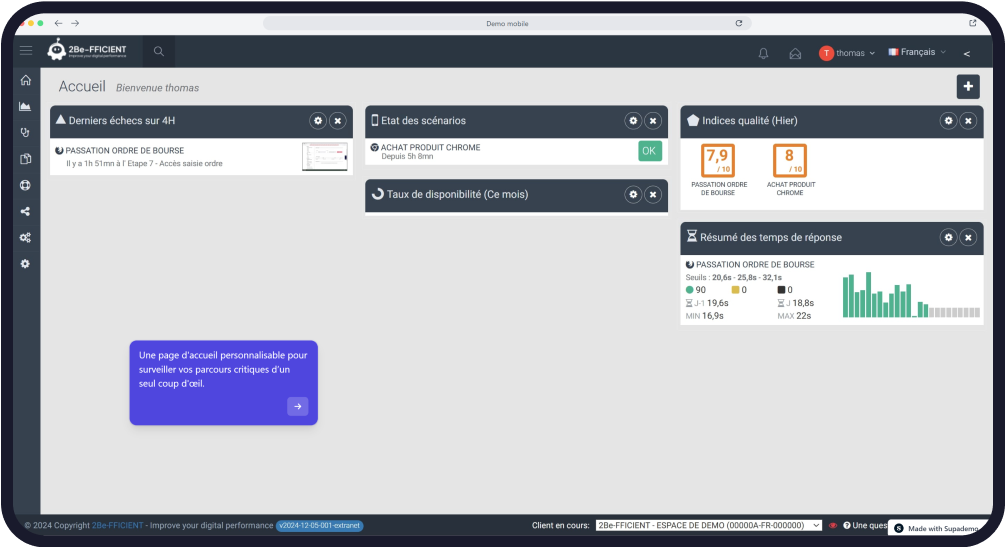
Integrating 2Be-FFICIENT into your mobile application performance optimization strategy means you benefit from a comprehensive, advanced solution. 2Be-FFICIENT offers in-depth analysis and precise recommendations, helping you to minimize loading times, optimize resources, and enhance the user experience.
Thanks to proactive real-time monitoring, you can detect anomalies and resolve problems before they affect users. 2Be-FFICIENT ‘s UX optimization tools enable you to design intuitive and efficient interfaces, improving user engagement and satisfaction.
What’s more, real-time reporting and predictive analysis features help you anticipate your users’ future needs.
By adopting 2Be-FFICIENT’s solutions, you ensure an exceptional user experience and keep your applications performing reliably, guaranteeing your company’s competitiveness in the mobile applications market.