This article explains what mobile app monitoring is and how it works. If you’re looking to set up real-world monitoring of your iOS and Android apps on actual devices, check out our mobile app monitoring solution →
**1 - Definition of mobile application monitoring
**
Monitoring ofapp mobile involves monitoring the various different facets of an application environment, with the aim of resolving identified problems before they become too serious. The aim is to optimize the user experience.
There are two types of monitoring: back-end and front-end.
Back-end mobile application monitoring involves monitoring all the technical elements that support the infrastructure required to run the mobile app. This may involve monitoring servers, databases, web services, etc. This monitoring is generally carried out by the app’s operational or development teams.

The monitoring of front-end mobile applications is more focused on the user experience. Monitoring will focus on the app’s behavior from the end-user’s point of view. Points of vigilance will focus on loading times, display errors, interactions with the user interface… In short, all the elements that could generate frustration on your users’ journey.
Why is mobile application important?
The use of smartphones and mobile apps is booming, and they’re used every day. User expectations are higher than ever. Mobile applications need to be fast, navigation smooth and malfunctions non-existent.
If it is not to be uninstalled at the flick of a finger, it must meet these requirements. It’s in this context that setting up an application monitoring system will enable you to quickly detect, analyze and resolve any slowdowns or malfunctions.
Monitoring the consumption of resources such as CPU, memory and disk is also important. It lets you know whether the mobile application is light or heavy in terms of resource consumption.
Key components of mobile application monitoring
The key components of this type of monitoring are :
-
Availability rate; The availability rate, as an essential component of mobile application monitoring, indicates the proportion of time during which the application is operational and accessible to users. A high availability rate ensures that the application is reliable and constantly accessible, thereby minimizing service interruptions and maximizing user satisfaction.
-
Data collection: Mobile application monitoring uses data collection tools to obtain information on application performance. These tools collect data such as response times, page load times, errors, crashes and more.
-
Data analysis: Collected data is analyzed to identify problems and trends. Key metrics include average response time, availability rate, crash rate, query execution time, etc. Data analysis helps detect bottlenecks, bugs and performance problems.
-
Alerts and notifications : Software monitoring can also send alerts and notifications in the event of critical problems. This enables developers to react quickly to problems and resolve them before they affect the user experience.
-
Dashboards and reports: Data collected and analyzed can be visualized using customized dashboards and reports. These dashboards provide a real-time view of application performance, enabling developers to monitor key metrics and make informed decisions.
-
Integration with other systems: Mobile application monitoring can be integrated with other systems such as incident management tools, development platforms and data analysis tools. This enables developers to gain an overview of application performance and make more informed decisions.
Using these key components, mobile application monitoring enables developers to quickly detect and resolve performance problems, improve the user experience and optimize overall application performance.
2- How does mobile application monitoring work?
Mobile application monitoring is the process of monitoring and analyzing the performance of a mobile application in real time. This enables application developers and owners to detect performance problems, and optimize and improve their user experience.
There are several key performance indicators (KPIs) in mobile application monitoring, which can be divided into different categories:
A. Application performance KPIs
These KPIs measure the speed, stability and availability of the application.
- Response time: Measures the time between a user action and the appearance of the expected element.
- Availability rate: Overall measure of the probability that the application will be ready for use.
- Transaction success rate: Measures the percentage of transactions successfully completed by the application.
- Application loading time: It measures the time required for the application to load completely.
B. Usage KPIs
These KPIs evaluate how users use the application.
- Number of monthly active users (MAU): This measures the number of unique users who have logged on to the application at least once in a month.
- User retention rate: Measures the application’s ability to keep users coming back on a regular basis.
- Average time spent in application: Measures the average time a user remains active in the application.
C. User satisfaction KPIs
These KPIs evaluate user experience and overall user satisfaction.
- Application rating: Measures the rating and comments left by users in app stores.
- Uninstall rate: Measures the number of users who have uninstalled the application after using it.
- Number of bugs reported: This measures the number of bugs reported by users and the time taken to resolve them.
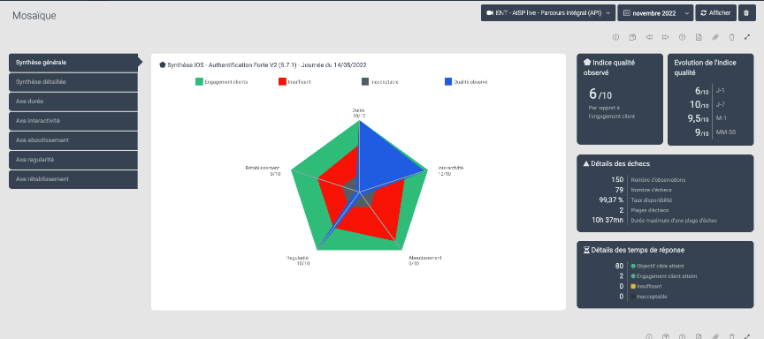
- Quality of service by comparing the quality delivered with the level of quality expected by users, according to certain criteria. At 2Be-FFICIENT , we deal with this indicator in the context of a specific report: Vision Décisionnelle.
D- Monetary KPIs
These KPIs assess the application’s financial performance and profitability.
- Revenue generated: Measures the total amount of revenue generated by the application (article sales, advertising, subscriptions, etc.).
- Cost per installation (CPI): Measures the average cost spent for each installation of the application.
- Conversion rate: Measures the percentage of users who have made a purchase or monetized an action in the application.
Mobile application monitoring collects this data, analyzes it and presents it in the form of reports and dashboards, enabling developers and application owners to make informed decisions to improve the performance and user experience of their application.
The benefits of mobile application monitoring
-
Improved performance: Mobile application monitoring can detect performance problems such as slow loading times, frequent bugs or crashes. This enables developers to quickly resolve these issues to improve the user experience.
-
Reduced downtime: By monitoring application performance in real time, developers can detect and resolve problems before they cause major downtime. This reduces disruption to users and improves application availability.
-
Resource optimization: Mobile application monitoring enables you to monitor the use of resources such as memory, CPU and battery consumption. This helps identify optimization problems and improve overall application efficiency.
-
User data collection: Mobile application monitoring enables you to collect data on users, such as their usage behavior, preferences or interactions with the application. This information can be used to personalize the user experience, improve application functionality or guide future development decisions.
-
Enhanced security: By monitoring application errors and abnormal behavior, monitoring can detect intrusion attempts or security vulnerabilities. This strengthens application security and protects user data.
-
Monitoring the performance of updates: Mobile application monitoring measures the impact of updates or new features on application performance. This ensures that changes made do not adversely affect the user experience.
-
Cross-platform monitoring: Mobile application monitoring can be carried out on different platforms, such as iOS, Android or Windows. This ensures consistency in application performance, whatever the operating system used by the user.
-
Increased responsiveness: By monitoring application performance in real time, developers can react quickly to problems and resolve them before they become critical. This improves user satisfaction and prevents potential loss of revenue due to application problems.
3- Mobile application monitoring that combines application performance and user experience user experience: 2Be-FFICIENT
2Be-FFICIENT is the mobile application monitoring solution that sets itself apart by offering a comprehensive approach that combines application performance and user experience monitoring. Using real devices, our automated systems monitor customer journeys on mobile 24/7, providing real-time feedback on any malfunctions.
Thanks to 2Be-FFICIENT, all interested company departments can obtain a clear and detailed view of the performance of their mobile application, from both a technical and user experience point of view.
The solution allows you to monitor key indicators such as response times, errors, loading times, availability rate… but also any display errors, authentication problems or links with third-party applications that could pose a potential problem.
By identifying friction points, teams can take proactive steps to resolve them before they adversely affect users.
By combining performance and user experience monitoring, 2Be-FFICIENT offers a comprehensive and in-depth view of application health, enabling companies to make informed decisions to improve the performance, stability and user experience of their mobile applications.