Automated API (Application Programming Interfaces) testing is one of the techniques used to monitor a website or application. It is essential for detecting errors, verifying reliability, and measuring the performance of an interface. It helps to ensure service continuity and a smooth user experience, which are key elements for an optimal user experience. Thanks to their automation, they can be performed regularly, thereby helping to improve the functionality of a website or application.
To fully understand the challenges involved in this monitoring, this article will introduce you to the various API tests, the advantages of automating them, and the best practices to follow.
To go further, discover our API monitoring solution.
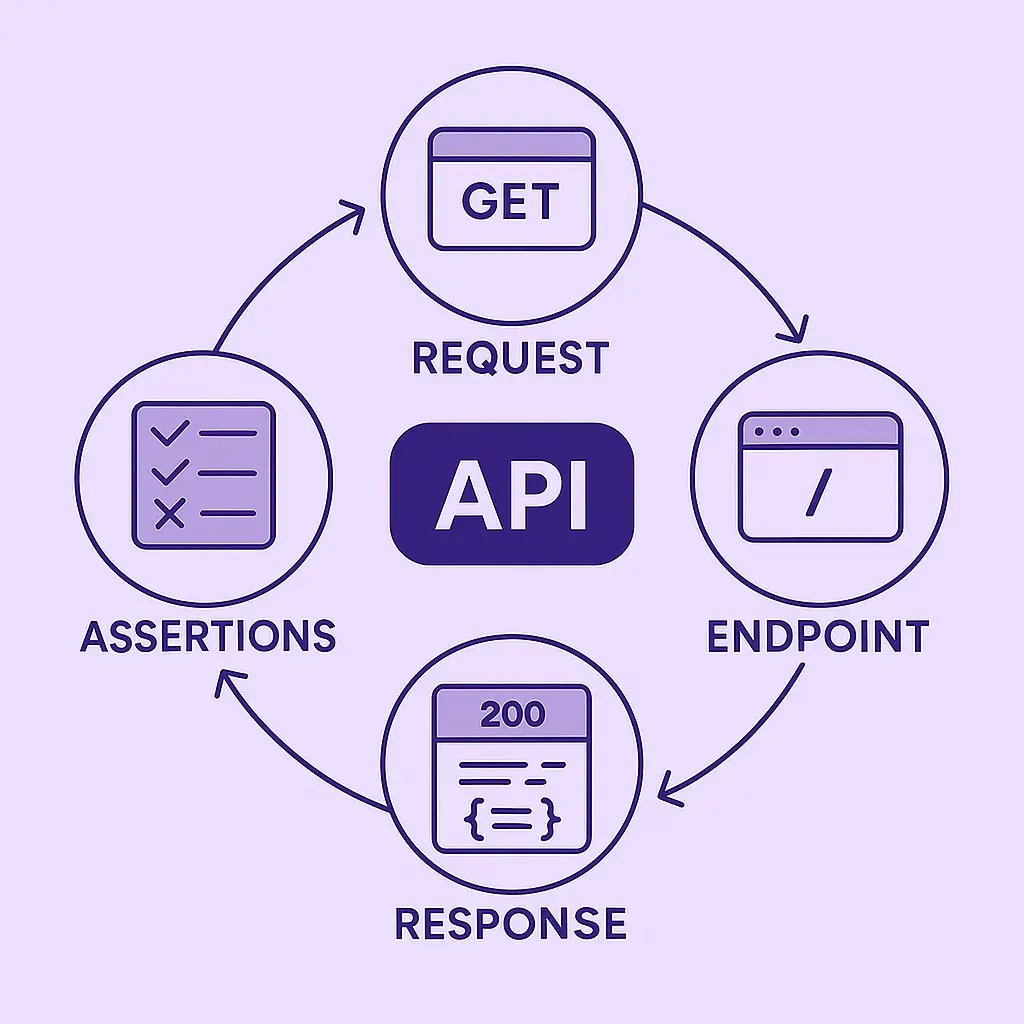
What is an API test?
An API test consists of verifying that an API is functioning correctly and meets expectations in terms of:
- safety
- performance
- reliability
- business features.
During this process, requests are sent to various API endpoints, and the responses obtained are then compared with the expected results.
Similarly, an API test can be:
- carried out during the development process of a website or application and after it has been launched,
- automated or manual.
There are several of these, which analyze a specific aspect of how an interface works.
Functional test
During this test, the specific functions of an API are checked to ensure that it works within the expected parameters. Any results outside these parameters are considered errors that must be corrected.
Data validation test
This involves checking the API’s operational efficiency, its management of formats, and data errors in particular. For example: how does it react when a user forgets to enter the @ symbol in their email address?
Performance test
The purpose of this test is to measure the speed, response time, and capacity of the API to handle numerous requests.
Reliability test
This test analyzes the API’s ability to produce consistent results over time, even under stress or variations.
Safety test
This test focuses on encryption methods and API access control, including the management of user rights for a site or application.
Penetration test
This test is based on the results of the security test and allows the angle of attack of an API to be analyzed from an external perspective, i.e., with limited knowledge of the API.
Fuzzing test
During this test, very large amounts of data are sent randomly into the system in order to cause congestion and evaluate the API’s response.
Whether automated or manual, API tests ensure the reliability and security of connections between platforms.
Good to know:
API tests are a cornerstone of synthetic monitoring, as they automatically reproduce technical scenarios that are essential to the smooth running of user journeys.
What is API test automation?
Automation refers to the automated process of API testing. These tests are not performed manually by developers. They are performed by automated agents using automated scripts that replicate the behavior of users on your website or application.
They therefore evaluate the functionality, performance, and security of APIs in the same way as manual tests. This is also the method proposed in our API monitoring solution.
Thanks to automation, you can:
- systematize testing to ensure consistent and optimal coverage, while minimizing human error
- plan their execution
- Save time and avoid having to mobilize your developers to carry them out (they can then focus on other tasks, such as developing new features or critical tasks requiring their expertise).
- detect errors more quickly.
Why perform automated API testing?
Automated API testing allows you to:
- implement regular testing
- optimize this process
- quickly identify and resolve problems
- facilitate data tracking
- improve their coverage, which is broader than that of manual tests because all components of the system can be verified
- obtain consistent results across multiple loops
- detect errors and anomalies that negatively impact the user experience early on, and prevent them from accumulating
- reduce testing times
- evaluate the performance and reliability of APIs in different situations
- detect and remove vulnerabilities in an application or website.
They play an essential role in a Digital Experience Monitoring (DEM) by ensuring the stability of critical technical components.
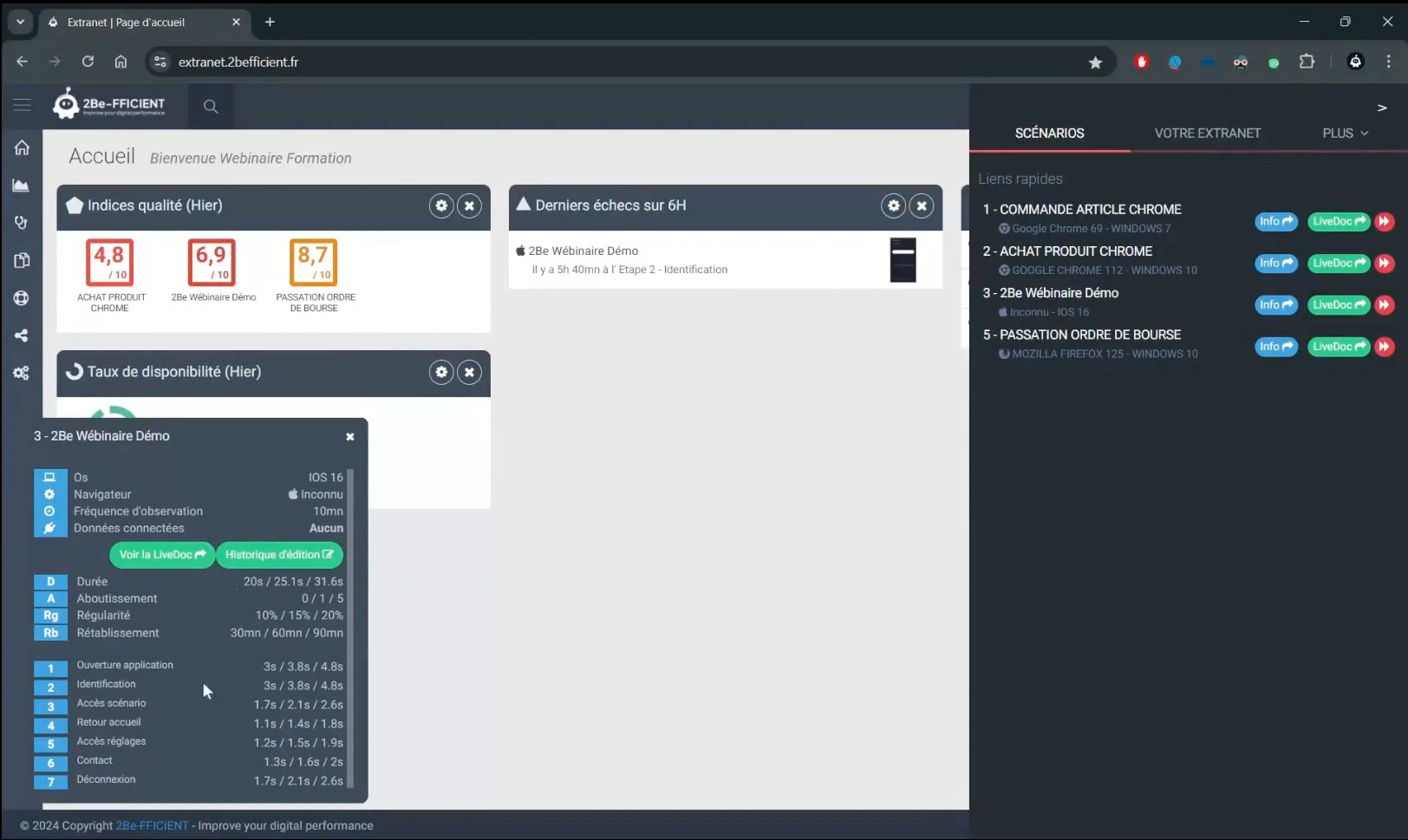
At 2Be-FFICIENT, our solution also provides you with real-time alerts when problems are detected, accompanied by a diagnosis. This helps you resolve them quickly and improve service quality. The ultimate goal is to optimize the user experience and performance of your website or application.
What are the best practices for successful API test automation?
API test automation is a real asset for your business. But it still needs to be implemented successfully. To do this, it is advisable to:
- First perform manual tests to check their impact on your interface.
- avoid complex automation logic that can lead to false positives
- run automated tests in parallel (on different devices, browsers, and operating systems) to avoid bottlenecks
- Choose a solution that is compatible with your workflows (this is the case with our 2Be-FFICIENT solution, 2Be-FFICIENT works on all types of APIs).
- store the data obtained independently of automated scripts so that it can be reused without having to modify the scripts
- Perform tests regularly, not just before launching a website or application.
These best practices are at the heart of our API test automation solution.
Discover how 2Be-FFICIENT automate your API testing and monitor your APIs in production.
Request your personalized demo now.